• Due to an exhausting spring quarter, I’ve been terrible about keeping up with my blog.    While I haven’t had much time to blog, the training has continued.  Along with rally (see last post), Rozzie is starting to shine in her agility training.  She’s recently figured out her weavepoles, at least in the backyard.  Here’s a short clip as proof:

    The next steps will be to work on more difficult entries (which is what I’m doing when I’m calling her through three poles–she’s coming at the poles from different angles), taking her weavepoles “on the road” so she can do them in different locations, and start adding poles so she can eventually do twelve for the advanced classes.  Yeah Rozzie!

  • Rozzie happily surprised me today by being the star of the rally match held in Auburn, WA.  I took all three dogs, as I’m hoping both Rozzie and Reardon will be ready to compete in rally obedience by our National in October.  (Rally is an obedience competition where the dog and handler team perform exercises provided by signs placed in a pattern in an obedience ring.) 

    Nine months ago, Rozzie was spooked by a rally judge and barely finished the course.  It didn’t help that the judge was literally running up behind us to keep score.  Today, Rozzie showed outstanding attention.  She didn’t even notice the judge or the timer when we walked onto the course.  She got one cookie on the course–during the down exercise–and other than that, food was on me but invisible.  Moving from food to no visible food is always a big transition, but Rozzie is handling it far better than her brother in new locations.  Here’s her rally run for 100 points (a perfect score):

    Good girl, Rozzie!

  • The first week of a new school quarter really slowed my blogging down.  I’m catching up with some photos of a wonderful Thursday during spring break spent visiting a local retriever trainer who is the choice of many Irish Water Spaniel folk: Andy Fontenot of Waterdog Kennels.  He is respected for his patience and understanding of the temperament of the Irish Water Spaniel–quite different from the Lab–and for his ability to treat every dog as an individual and tailor his training program to that individual. 

    I got to see three Irish Water Spaniels at work: two at the beginning junior level, and one working the  much more advanced and challenging senior/master level.  The two junior dogs are Jezebel and Journey.  Joey is the advanced IWS, currently working on his senior hunt test title so he can then move to master, the highest level in hunt tests. 

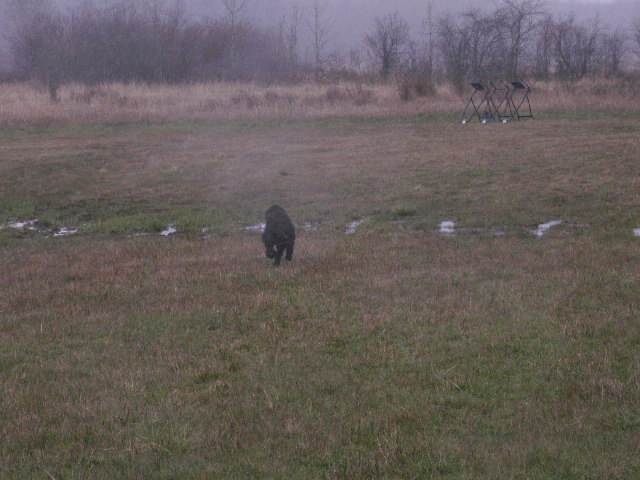
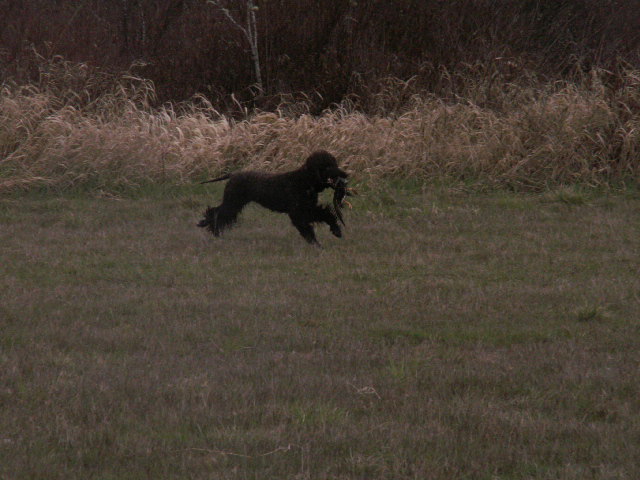
    Here’s Jezebel first.  You can see she’s working with birds thrown by an assistant off to the right of the photo.  Andy said this was her first experience with someone other than him throwing, so it took her a few minutes to get the idea of marking a different thrower.   There will be a person standing fairly close by at the hunt test, so she’ll need to get used to him.  Once she gets the idea, she heads out with confidence and speed:
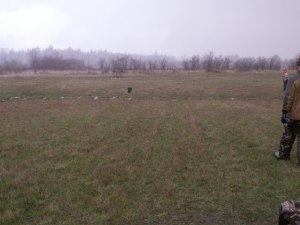
    This is another retrieve in the same area.  You can see the rain is beginning to fall.  The dogs could care less; it’s the humans who are complaining!
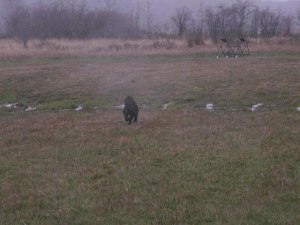
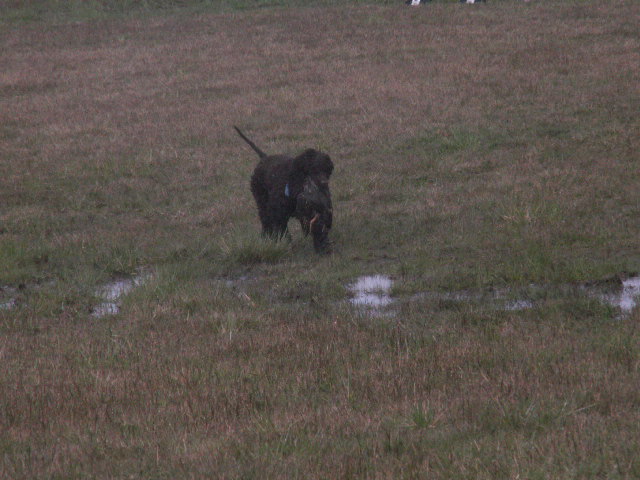
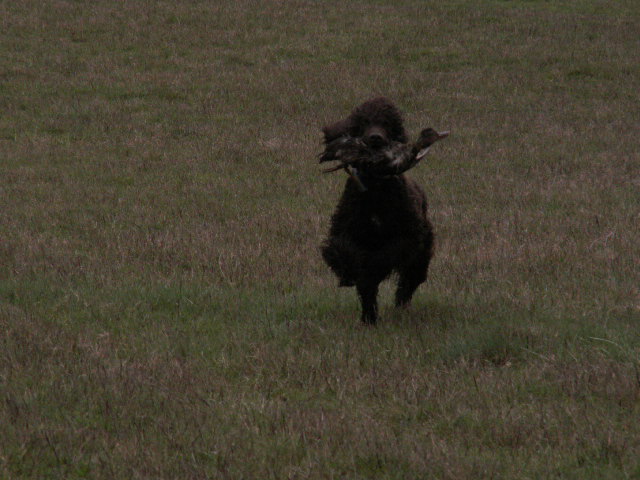
    Jezebel’s a good girl and brings her bird right back. 
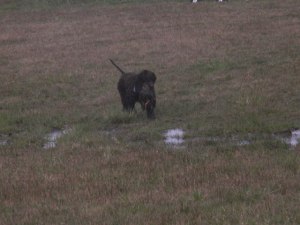
    This is yet another retrieve photo where the thrower has moved slightly, and just a bit further out.  Jezebel is continuing to show a lot of enthusiasm for her retrieving.  All in all she had about 10 retrieves.  A less driven dog would have lost interest after 5 or so, but Irish Water Spaniels tend to be dedicated retrievers.  Jezebel is no exception.  Andy says she’s a soft girl, but very enthusiastic and willing about her work.

    Jezebel brings back yet another bird.  She’s showing all the willingness of a natural retriever–desire to retrieve over and over again, and willingness to bring the bird back to Andy.  (See my earlier post about the natural retrieve.  It gets more complicated when the object is a highly desirable one, like a bird!)
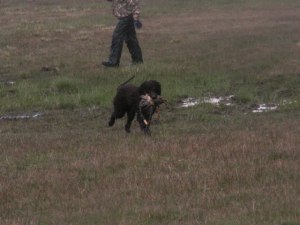
    Now it’s Journey’s turn.  She’s taken to the training well, and brings her birds back with style and speed:

    This photo shows you that Journey is working slightly longer distances, using a mechanical thrower.  That’s Andy in the foreground, so his position gives you a sense of where the retrieve started.  Andy says Journey is “taking her marks well,” meaning she is noting the fall of the bird well from a distance, and is able to pinpoint where to go easily. 

    This next photo shows Journey heading into some light cover to complete a retrieve.  She’s marking that the bird fell into cover, and will head into the high grass to find the bird.
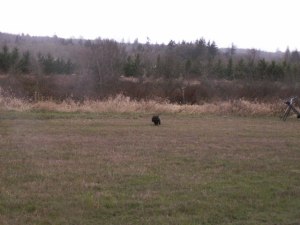
    Good girl!  Journey finds her bird and brings it back.
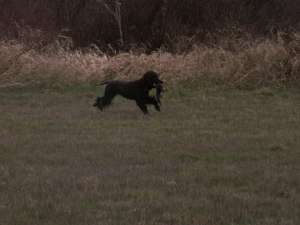
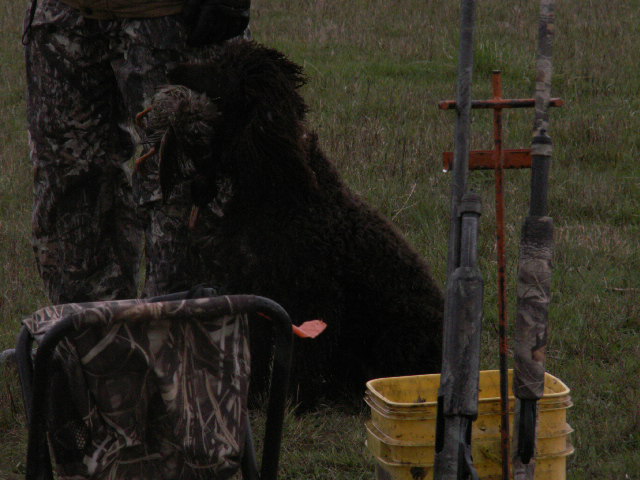
    Another piece of the finished exercise is that the dog brings the bird all the way back to heel position, at the same time lining up for the next “mark.”  Journey has this one down, as she returns with her bird to Andy’s left side. 

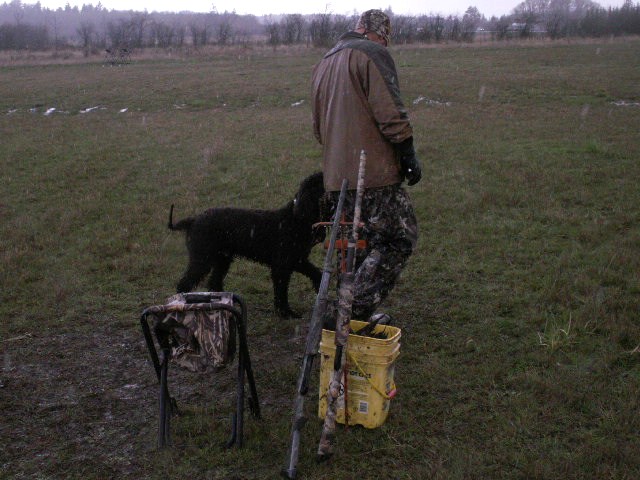
    Joey is the real star of the show.  He’s training at the more advanced levels, and his work is quite impressive.  He’s working much longer distances, with multiple marks, meaning 3 birds thrown out in different areas, and he has to remember where they are.  Here you can see him “taking the mark” of one of the birds at Andy’s side.
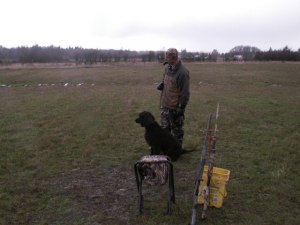
    Here’s Joey returning with one of his first birds.  The rain is starting to come down again.  Joey pays it no mind.
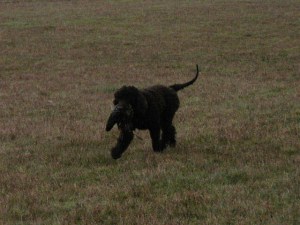
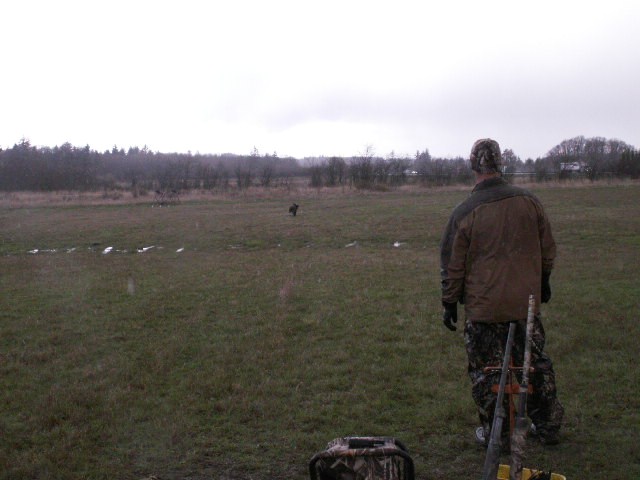
    Here’s Joey heading out on his second mark (that he has to remember from prior to his last retrieve).  You can get a sense of the greater distance of Joey’s retrieves; he will get to the light brown cover in the distance before he recovers his bird.  This is over twice the distance of the retrieves of Jezebel and Journey.
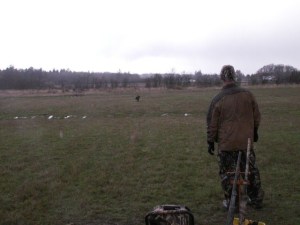
    Here’s Joey retrieving the bird in light cover.  A bird buried in cover also requires Joey to use his nose to find the bird’s fall.  From a distance, he can mark the general area of the fall, but once he gets there, his nose goes to work.   Good boy, Joey!

    After Joey has retrieved his three marked birds, Andy sets him up for one last blind “dead” retrieve.  In this exercise, the dog has not seen the fall, and must follow the trainer’s direction to find the bird.

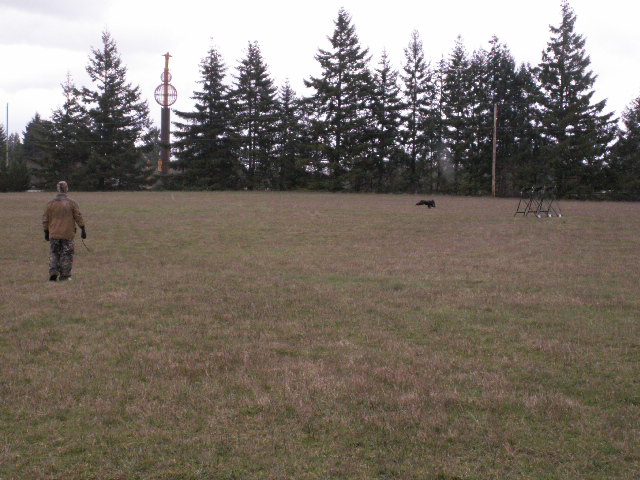
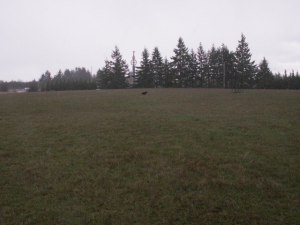
    With this next photo, I was hoping to catch Andy whistling Joey to a sit, so that he could more effectively direct Joey to the bird.  Instead, I caught Joey just slowing down to take Andy’s command.  You can get a sense of the impressive amount of distance.  Joey had even farther to go–almost to the treeline–to find the bird.  He sat on command numerous times, followed Andy’s direction, and find his bird.    Good boy!
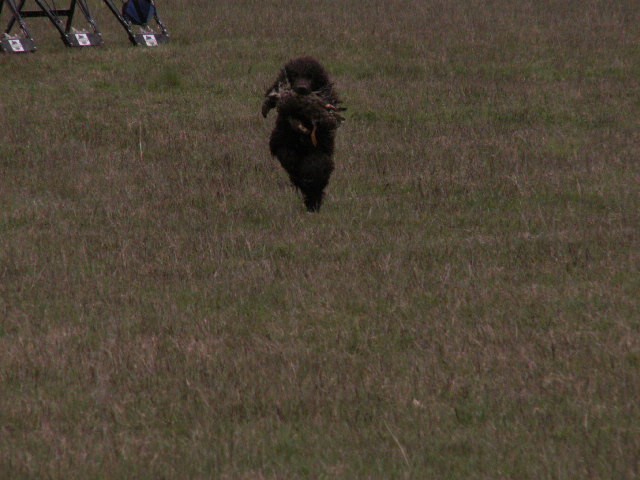
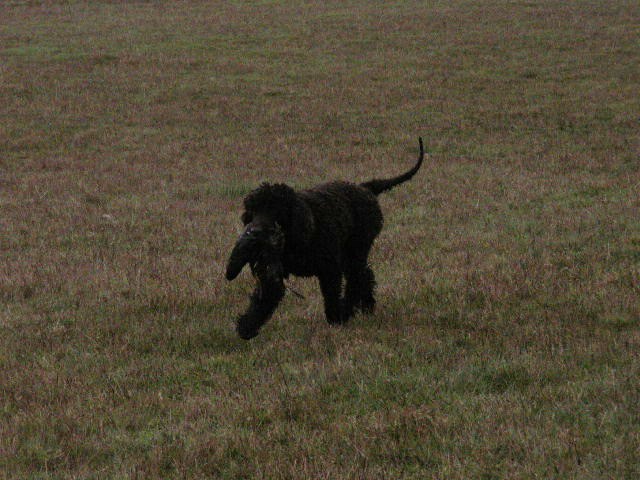
    This photo essay ends with one more photo of Journey just because I love her enthusiastic return.    It’s clear with all three of these Irish Water Spaniels that they love their birds and they love their work.

  • To guide me in my physical training of my dogs, I look to great trainers in the dog world.  But for my mental preparation, I often look to other sources.  One is the horse world, where the mental preparation and attitude of the rider has been a topic of discussion for decades, if not centuries.  The art of equitation goes back 2000 years to Xenophon, and modern theories of classical riding have a 400 year history.    So why not look to the masters?

    One favorite inspirational text I read when I need my priorities refocused is by Erik Herbermann, an internationally respected horseman.  His book Dressage Formula is considered a classic.    


    While much of it is technical instruction, the first chapters outline the importance of the rider’s mental preparation. Whenever I read them, I am struck by their wisdom, and how easily they relate to the dog/human training relationship.  Below is an excerpt from his first chapter.  All I’ve done is substituted “dog” for “horse” and “training” for “riding”:

    Training is about:

    • respect for, and love of, the dog
    • trust-loyalty-friendship
    • incorruptible commitment to the dog’s well-being
    • coming to an understanding of the nature of the dog
    • enhancing the dog’s beauty through gymnastic work
    • enjoying a harmonious relationship
    • an avenue to self-awareness; self-improvement

    Our tasks are:

    • to be the leader of the partnership
    • to know that the “buck stops here” (note: exclusively with the trainer.  ‘Management’ is always solely responsible for finding viable solutions to all problems.)
    • to have clarity of purpose
    • to work within the dog’s and our own capabilities
    • to utilize praise and correction; punishing extremely rarely
    • to be thoughtful, patient, kind in all interaction with the dog.

    Need I say more?

  • In Scent Work Part 1, you saw two springers, Kani and Rozzie, at the opposite ends of their training in the scent discrimination exercise.   Reardon’s right in the middle stage.  He’s had literally months of developing confidence with cheese strips on the articles.  The cheese strips have been gradually faded to where they’re really just a dot of cheese.   All this time, the cheese has served two purposes: one, to provide Reardon with an instant reward for indicating the right article; and two, to associate my scent with something really good.  So the cheese really combines two powerful training techniques: operant and classical conditioning (more on that some other time). 

    Now the big moment is here, where the cheese needs to disappear and Reardon needs to make independent choices about which article is the correct one.  It will now become possible for him to make mistakes (which he hates!) and he’ll have to recognize he gets a delayed reward for finding the right article.   That’s why he receives so many tasty treats when he comes back to me. 

    Most trainers only post videos where everything goes perfectly.  But I think it’s more interesting to look at videos where things go wrong. In this first video, filmed last Friday, Reardon makes a mistake, knows it, and then displays various avoiding behaviors as the exercise becomes stressful:

    I could make a crucial mistake here and try to correct Reardon when he avoids going to the pile of articles, using a collar pop or an ear pinch.  (My first competition obedience instructor, as talented as she was, instructed me to do this with Hank.  Scent discrimination was a stressful exercise for him for the rest of his life.)  I’ve learned, however, that in the learning phase of any exercise, to reduce the stress as much as possible on my end.  We need to have success!  Hence I help him while still trying to get him to make his own decisions. 

    By the next video, filmed only two days later, Reardon makes that remarkable leap forward in his training:

    He finds the right articles with minimal help from me, no cheese, and no avoidance!  What a guy!  Now we can move forward to gradually adding more articles in the pile and doing this exercise in different locations.  He’ll continue to make some mistakes, but we’ll work through them using the same techniques you saw in the first video.  Reardon is over the training hump.  This is always an exciting moment to experience!

  • Human beings are always fascinated by the dog’s ability to use his nose.  While our primary sense is our sight, the dog’s nose dominates his perceptions of the world, through scent receptors that are thousands of times greater than ours.   So training a dog to do scent work is really diving into a world we don’t understand–a mystical, blind world that the dog understands naturally, but we can only make educated guesses about.

    I’m in an unusual training period right now where I have three springers at very different stages of their scent work for obedience trialing.  The “scent discrimination” exercise in obedience requires the dog to select from a pile of articles (dumbbell-shaped objects of metal and leather) the one article that the handler has scented.  The dog must do this twice, once with a metal article and once with a leather one.  Here’s Kani performing this exercise at a recent trial in January:

    While audiences are often deeply impressed by this exercise, by this stage the scent work itself is not the challenge for Kani.  Rather, it’s the fact that the scent work is occurring in a new building, a distance away from me, with a stranger standing nearby with a clipboard. With all of these external distractions, Kani has to concentrate and continue working until she finds the right article.   This is tough for the impulsive spaniel!    I mentioned in an earlier post that this particular show site is stressful for Kani, and you can see that stress playing out in her hesitation over the metal article.  She indicates it, but still checks everything else and then rolls the article a bit before picking it up.  These are all signs of stress. 

    Because of the inherent stress of this exercise, I’ve realized how important it is to teach the baby steps of it very early, in a way that is non-stressful and is a “win-win” situation for the dog.  The method I like best was created by Janice DeMello, a nationally recognized dog trainer.  It’s called the “round-the-clock” method.  Rozzie is just now being introduced to this method, but this can be done even with puppies.    At this early stage, the trainer’s scent is associated with a small strip of cheese  that is sprayed on the article.  The dog simply has to find the article with the cheese on it, lick it off and then return to the trainer.  Even though Rozzie can retrieve, I don’t ask her to retrieve the article.  Instead, by putting the articles in a circle (the “clock”), she’s learning to scent in a pattern and indicate the correct article.  This exercise has to be FUN, and she needs to be 100% RIGHT.  If that doesn’t happen, I’ve messed up.   This video is fairly long because as you’ll see, the articles are put out gradually so that she learns a pattern of searching.

    In training dogs to track human scent, most trainers use some sort of secondary motivator, like food, to teach the dog to follow a particular scent.    After all, the dogs know how to use their nose!  It’s really a matter of the human communicating, “Follow this track, not that one.”   In training, tracks laid by humans are laced with hotdog pieces, that are gradually faded as the dog learns to follow that scent.  I’ve heard that many police trainers, in training their dogs to follow scent across asphalt (a much more difficult surface because of the lack of ground material to hold scent) will use a spray bottle of urine produced by females in heat! 

    You’ve now seen videos of two dogs working scent at the opposite sides of the spectrum: Kani, who has been doing this kind of scent work for years, and Rozzie, who is just beginning.  The next post will show Reardon making the transition to eliminating the cheese and indicating my scent only.  It’s a big leap.

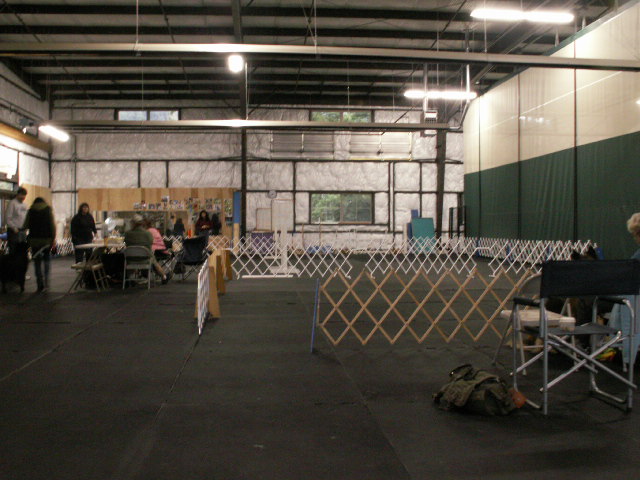
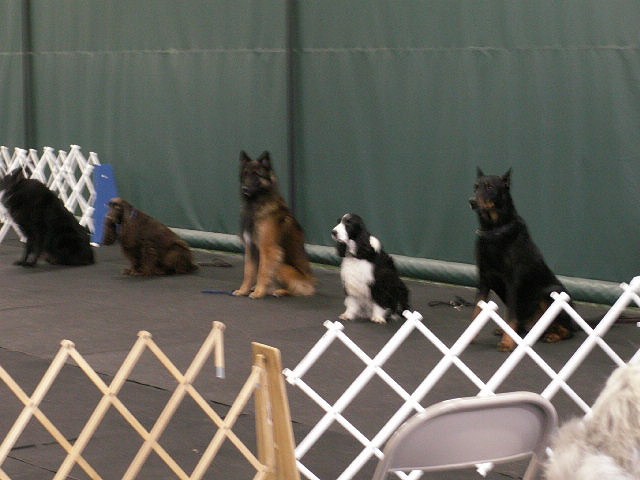
  • Sunday we  headed to a fun match held by our local spaniel club.  In a “fun match,”  we get to practice our obedience exercises in a show-like setting, with volunteers acting as  judges and stewards.  It’s not the real thing, but a busy, well -run fun match has much the same feeling as a show.   This match was held in an obedience/agility building down in Sumner, WA:

    Both Kani and Reardon had a chance to practice their obedience routines, and both of them did a great job.  I’m excited with how Kani’s work is coming along, with some trials coming up in late February and March.  Unfortunately Rozzie is in season, so she couldn’t participate this weekend.  In obedience trials, bitches in season can’t compete as their scent will be too distracting. 

    Most of my pictures didn’t turn out well–my relationship with my Minolta is an on-going battle of small triumphs and big disappointments.  But here’s a fuzzy picture of Kani doing her sit stay (3 minutes with me out of sight):

    The day continued to go well until I packed up to leave and tried to start the car.  I say “tried” because it wouldn’t start.  Thanks to my very good dog friends and a mechanic who just happened to be nearby, we figured out how to get it going, so I could go home, drop off the dogs, and get the car to the dealer.  Not the way I wanted to end the afternoon–being stranded is always much more stressful when a carload of dogs is involved.  Blessing on my good dog friends for helping me, and fie on Dodge for building unreliable vehicles!

  • The more I’ve worked with different breeds, the easier it’s become to recognize some of the signs of a natural retriever.  Unfortunately not all hunting breeds have retained this ability, like the show-bred English Springer Spaniel and many setters.  In my recent introduction to the Irish Water Spaniel, I’ve found an intensity for retrieving in the breed  that is great fun to work with, and presents several hallmarks of natural retrieving.

    Sunday I had a chance to work with Journey, who has shown me a natural retrieve from the beginning of our relationship.  While her retrieve has been somewhat shaped since then, I haven’t done any consistent structured retrieve training.  Here’s a clip of some simple bumper work we did.  You can see I’m not worrying about “stay” at this point, but I’m in fact restraining her to keep her drive intense:

    So what are those hallmarks of a natural retrieve, that are evident in this clip and have been present in her work with me from the beginning?

    • In the first bumper throw, Journey gets confused by several objects on the ground.  A trainer would say she’s “missed her mark.”  Yet she continues to work at it until she finds the bumper.  This shows intense drive to complete the retrieve.  Less natural retrievers might simply give up or wander off.
    • Journey gallops out to each bumper, but more importantly, she gallops back in!  This shows how well Journey’s prey and pack drives are integrated.  She cares as much about bringing the bumper back to me as she does about picking it up.  Less natural retrievers will often shift to a trot coming back in, or even worse, a walk.  For them, coming back to the pack means taking the fun away.  For Journey, coming in is an essential part of the fun.
    • Journey willingly gives up the bumper to me–more of that pack drive.
    • I’m giving Journey some food treats, but it’s obvious that she cares much more about being praised by me and playing with me.  And she loves the bumper–it’s self rewarding.  I really don’t have to come up with secondary motivators for her to enjoy this activity and do it willingly.
    • Journey doesn’t let down after several retrieves.  In fact, we could keep doing this for quite some time before she gets bored.  A less driven retriever will lose interest after 2-3 retrieves. 

    Journey’s love of retrieving has all sorts of implications for the rest of her training.   Most importantly, her strong pack drive can be counted on in moments of stress, challenge and frustration.  More than anything, she wants to work with me and get praise from me.  In a stressful moment in training, her retrieve also gives me a quick “stress-buster” where I can just pull her bumper and get her prey drive going.  Her love of retrieving also gives us some alternate ways to teach some complicated exercises, like the “go-outs” in directed jumping, where the dog has to run to the other side of the ring and turn and sit on command.  Lastly, retrieving comes so easily to her, we can spend more of our time on other exercises!   Open is all about retrieving, so it’s a class that should come quickly to her.

  • I’m plotting a series of articles on the natural retrieve  for the Springer Spotlight, the parent club’s national publication,  so bits and pieces will be showing up here. 

    Spaniel field trialers speak confidently of their spaniel’s “natural retrieve,” lauding it as a mark of superiority over spaniels that must be taught this seemingly simple task.   By “natural,” they mean the retrieve behavior seems to be in-bred, presenting itself in early puppyhood and requiring very little training.  A field-bred springer spaniel without a natural desire and ability to retrieve is certainly looked down up as being of “lesser stock.”  

    While the retrieve is vital for fieldwork, it tells us far more than we realize about the dog’s trainability and character.   Here’s a quick clip of Kani in the obedience ring, performing a retrieve as a scored exercise.  Then we can break it down to its multiple parts to see how complex a behavior it really is.

    The most elemental pieces of this exercise, which can seen in a “natural” state are:

    1) desire and ability to “mark” (watch) a moving object.  Trainers working from a theoretical background will identify this as the dog possessing and utilizing “prey” drive.  In the world of dog training, “drive” really means “instinct,” which the dog is born with or genetically mapped with.  These drives can be observed in puppies as soon as all of their senses are functioning and they are mobile.

    2)  desire and ability to run out to the object.  This is really the “chase” portion of the prey drive.  Many dogs, depending on breed, will have a strong chase drive.

    3) desire and ability to pick up the object.  This is where the goal of the prey drive becomes apparent.  The object is picked up because it’s meant to be eaten.  Some dogs will now start chewing on the object (whether it’s a bird, bunny rabbit, dumbbell, or hunting dummy). After all, why would you have a prey drive unless it brought you food?  This is the beginning of any actual retrieve, but it’s not the full picture.

    4) desire and ability to bring the object back to the human.  This is a huge step, and takes the whole exercise onto a new level.  Here trainers will say the prey drive has been interrupted by “pack” drive–a drive that has been bred into many spaniel breeds to work with their human, rather than follow a very natural instinct to eat their prey. Young dogs will display conflict over their prey and pack drive by playing keep-away games with their human partners, rather than bringing the object back.

    5) desire and ability to release the object to the human.  Here is the ultimate in willingness to work with a human and forego the powerful prey drive.  The dog gives the object up willingly to the human.  In obedience trials, you’ll sometimes see dogs reluctant to do this, and hold onto the dumbbell while the handler tugs on it, trying to get the dog to give it up. It can become a rather embarrassing battle, not to mention significant loss of points in the ring.  In the field, this battle between prey and pack drive can cause the gamebird to be destroyed and unfit for human consumption. 

    So you can see just how complex this exercise really is.  It brings together two conflicting and complex drives, and ultimately asks the dog to work willingly with his human partner, even over the natural and profound drive to find sustenance. 

    The retrieve can be taught to almost any dog, using multiple motivators to make it a game, rather than an act of dominance.  However, many dogs are born with this entire exercise genetically mapped, including the willingness to bring the object back to the human.  This natural ability is amazing to watch, and can be seen in puppies as early as 5-6 weeks.  This is the “natural retrieve.”  Unfortunately for the show/pet bred English Springer Spaniel, this natural retrieve is being lost. 

    Many pet owners might not care about their spaniel having a natural retrieve.  But when we consider steps 4 and 5 above of the retrieve process, it becomes clear that the retrieve, particularly in its natural state, tells us a significant amount about a dog’s desire to work in concert with his/her human partner.   In short order, it can signify a dog’s willingness, obedience, trainability and “biddability.”    If the natural retrieve is disappearing in the show/pet bred Springer Spaniel, what else is being lost?

  • Last weekend kicked off the first “cluster” of dogs shows for the new year.  In our area, they begin at the Puyallup fairgrounds in mid-January, and then during the following weekend move down to Portland for 4 days of shows.  Because these two weekends cluster several days of shows, many professional handlers and big-name dogs come to Puyallup.

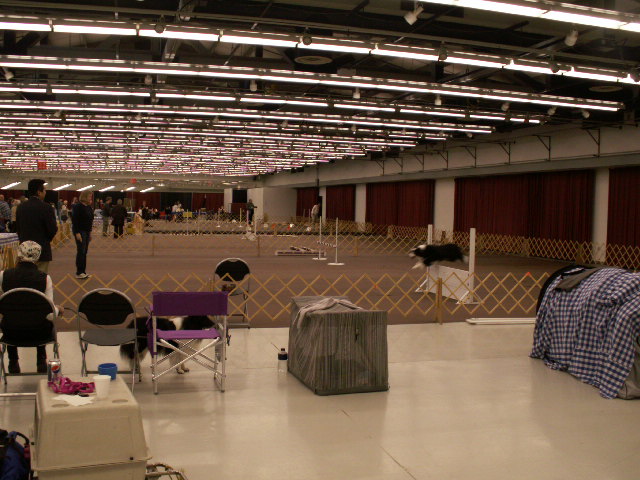
    The obedience trial, a sport dominated by amateurs rather than professionals, is held in a different building than the conformation rings.  Here’s what it looks like:

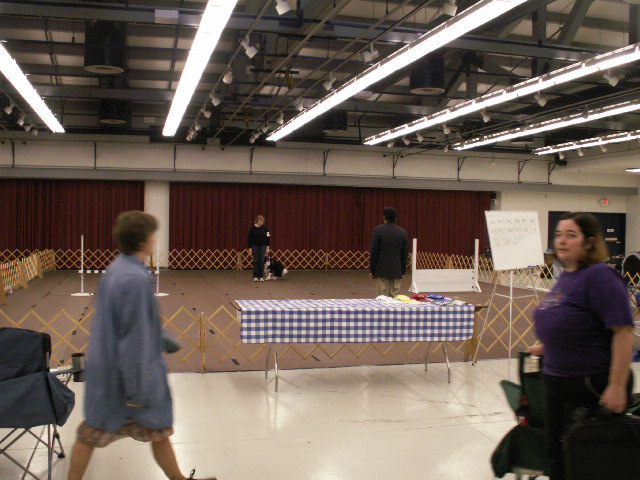
    The various rings are divided by baby gates, and in each ring a different class level is competing.  In the ring closest to the camera is the “Utility” ring, which is the highest class and certainly the most difficult.  Here’s another angle on the Utility ring.

    The person wearing the dark jacket in the ring with the dog and handler is the judge , and he (or she) calls out the various commands and scores the team.   

    Kani and I competed at this trial over the weekend, as well as in the “Open” ring, which is another advanced class.  By competing in both these classes, we have possibilities to earn points towards an Obedience Trial Championship (OTCH) if we beat other dogs.  Another opportunity is an advanced title called “Utility Dog Excellent” or UDX, which is earned by passing both classes on the same day.  It’s more of an award of consistency; the OTCH is an award for outstanding performance.

    Right now, to be honest, Kani and I are struggling with both.  Dog trialing certainly has its ups and downs, and we’re in a down.  Saturday she passed Utility and earned 4th place.  But 4th place wasn’t enough to earn us any OTCH points.  Then she flunked Open, by incorrectly performing one of the exercises that she usually does a great job with, the drop on recall.  Sunday she was only entered in Utility, and flunked that class, although some of the exercises she performed quite well.  (You have to pass each exercise in the class to earn a passing score, so if you flunk one thing, you’ve flunked the class.)

    Issues for her seem to be concentration and stress.  Certainly they go together.   My job is to sort out what is causing her stress, alleviate it in the ring, and increase her concentration.  The impulsive nature of the spaniel makes this more challenging.  But if obedience trialing didn’t have fascinating challenges, I wouldn’t still be doing it!