You might be wondering how the choreography for a freestyle routine is developed, and then how it gets written down for future reference. There are plenty of options, but I thought it would be helpful to see my messy notes for Kerrie’s new Advanced routine. Later this “roadmap” will get more developed, but this was my original brainstorm:
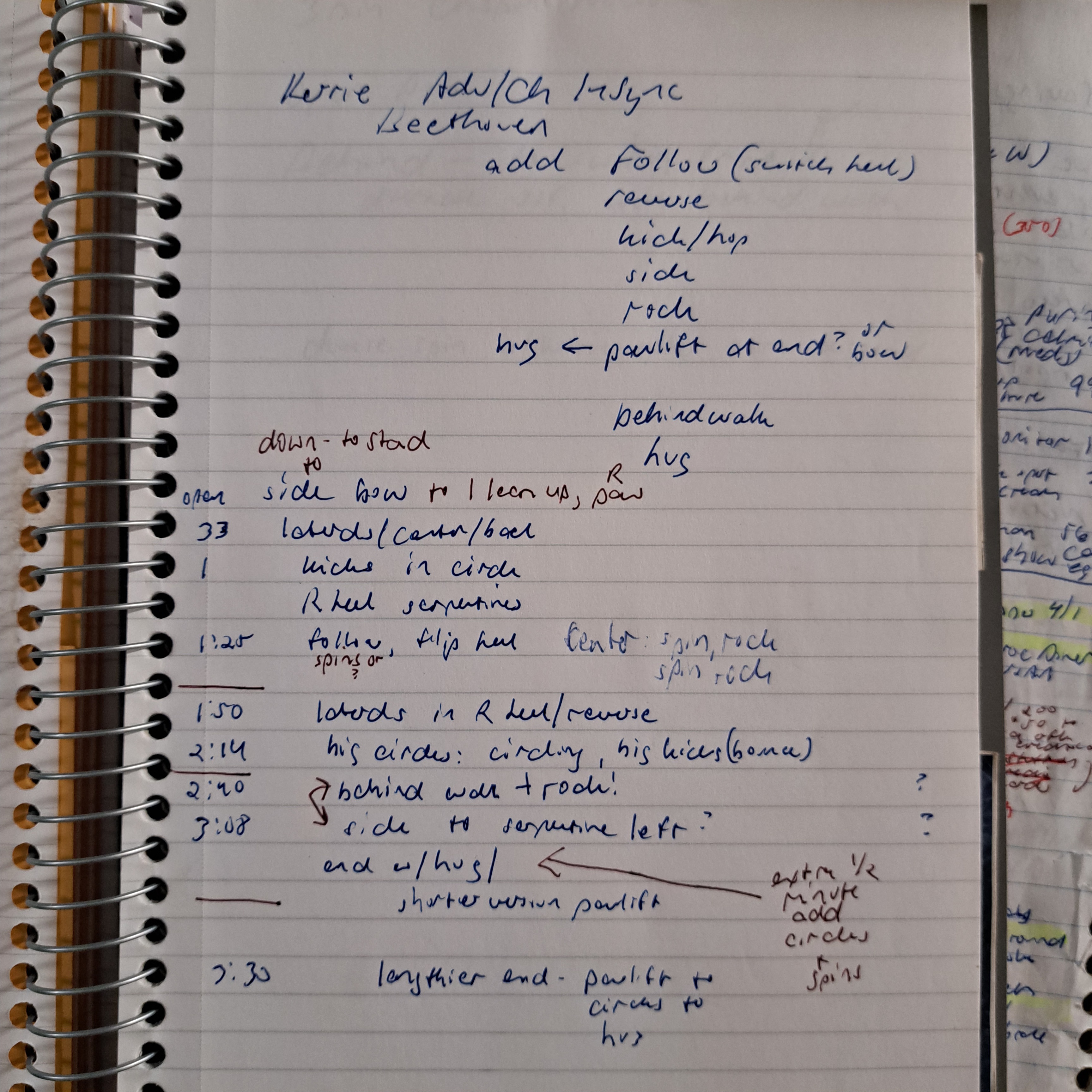
At the top is a list of behaviors I need to teach for this routine (chosen from another list I have of behaviors I want to teach Kerrie this year).
In the middle of the page the choreography starts. Because the music is instrumental, I chose to use time stamps to identify behaviors. Later I might add in musical remarks to help me remember a behavior (“trumpets blare” or “drums louder”). When a song has lyrics, writing down short lyrical phrases might be a more typical way to notate changes. You can see red lines within this timed list; they identify musical changes in tempo, key or mood that help me break the routine into smaller-size sequences for training. In other words, the 1st sequence starts 0:00 or “opening” ; the 2nd sequence starts at 1:50; the 3rd and last one starts at 2:40. I have a final sequence marked by the last red line that will be added as we move into the Championship division, where a longer piece is required.
How do I come up with the ideas for the different behaviors? It’s a mish-mash of listing Kerrie’s behaviors learned and soon-to-be-learned, along with dancing around in the living room on my own and letting ideas come to mind. I’ve found playing the song while driving also gives me ideas. There are foundational positions that help me develop a basis for the choreo–left heel, right heel, in front (center) and behind me. There are also transitions that will be added to these notes as we start putting bits of sequences together.
For instance, in the last sequence, getting to the position behind me can be as challenging as the rest of the “behind walk.” How do we get there? What are we doing before that and what is our transition from one behavior to the next? (Transitional behaviors will be another post!)
Anyway, I hope this shows you that choreographic planning doesn’t have to be complex or musical. I don’t lay out a score on the table and scribble in behaviors. I need something I can quickly reference as we’re training and easily adjust when something isn’t working quite right. There are many ways to notate choreography; this is mine.
 The Spaniel Annals
Leave a comment