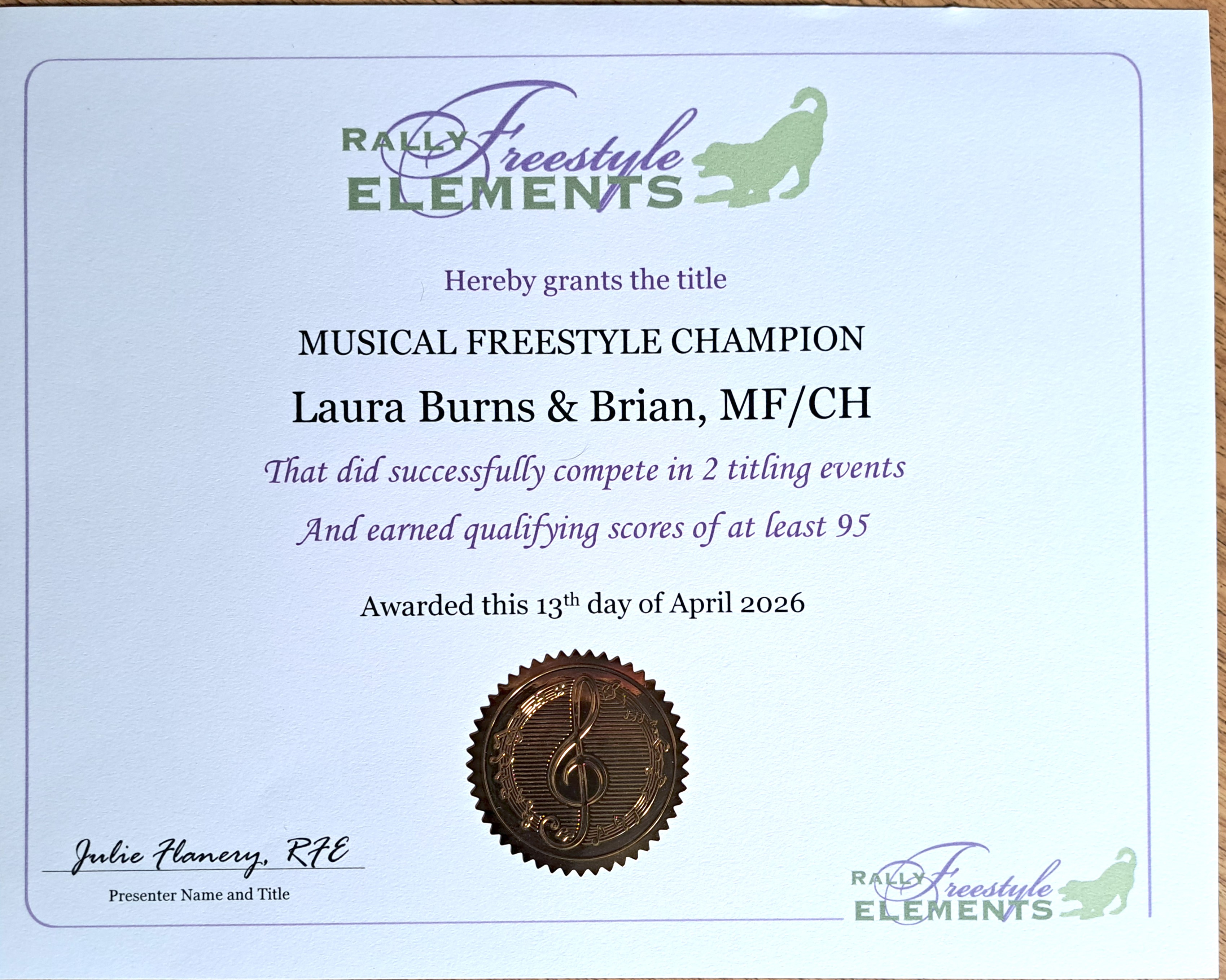
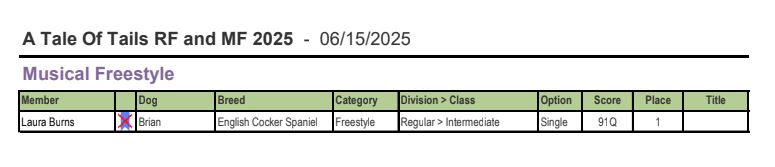
We recently received the happy news that Brian finished his Musical Freestyle Championship!
I have to confess the certificate is bit misleading; the rules changed recently to allow scores above 90 to count towards a championship. Brian’s scores were 93 and 91, with a bumper leg of 92 at a recent live show. I’m thrilled with that; he did his very best for this title and we had a lot of fun inventing and preparing it. The song is “Let’s Hear It for the Boy” by Deneice Williams, a song from the movie Footloose that certainly conveys how I feel about this dog.
Here’s his recent live performance at the No Frills at the Emerald Wall:
Brian is now semi-retired from showing in freestyle while he focuses on Utility obedience and scentwork. This also allows me to focus solely on Kerrie in freestyle, as she is showing a lot of potential. I hope you enjoy the performance as much as we did!
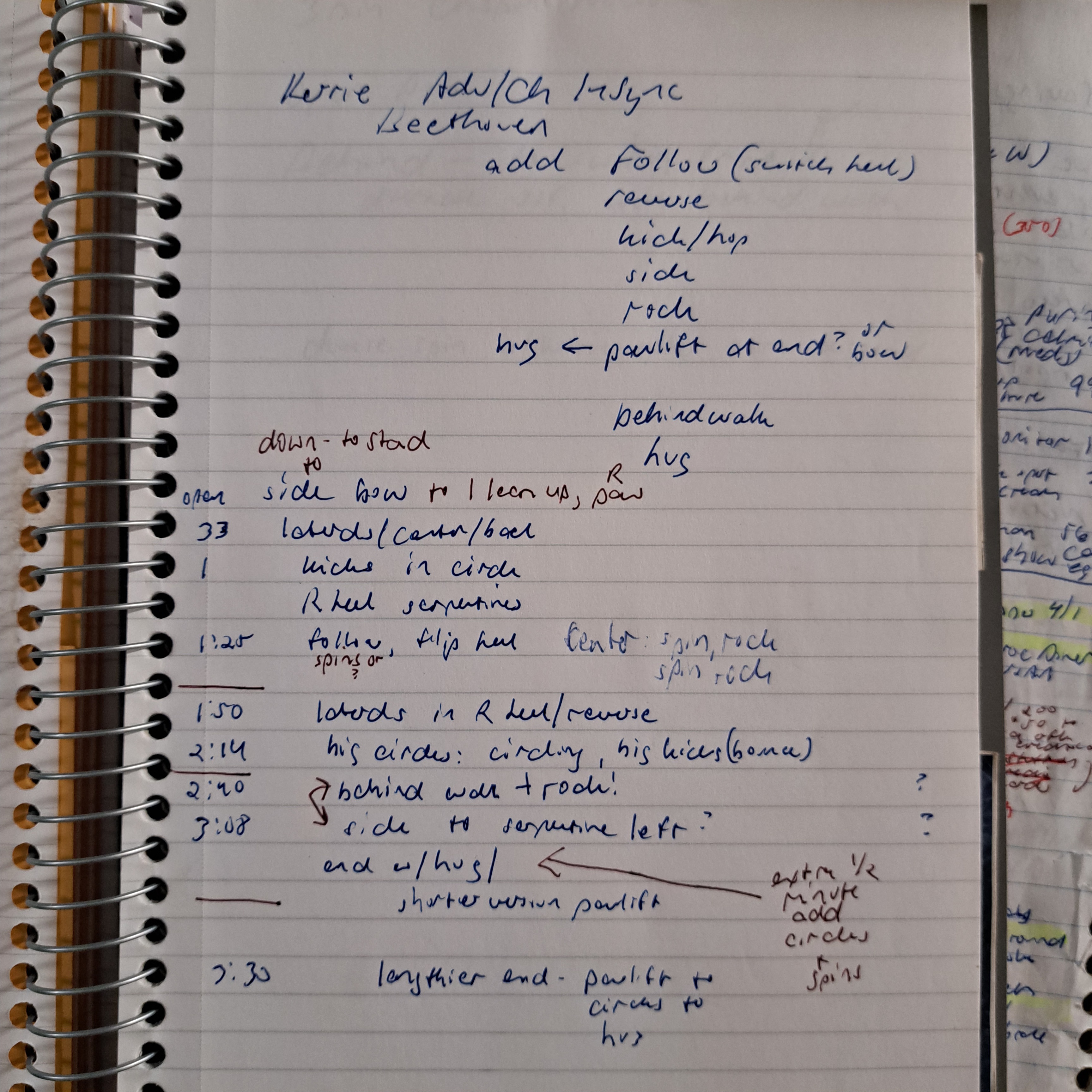
You might be wondering how the choreography for a freestyle routine is developed, and then how it gets written down for future reference. There are plenty of options, but I thought it would be helpful to see my messy notes for Kerrie’s new Advanced routine. Later this “roadmap” will get more developed, but this was my original brainstorm:
At the top is a list of behaviors I need to teach for this routine (chosen from another list I have of behaviors I want to teach Kerrie this year).
In the middle of the page the choreography starts. Because the music is instrumental, I chose to use time stamps to identify behaviors. Later I might add in musical remarks to help me remember a behavior (“trumpets blare” or “drums louder”). When a song has lyrics, writing down short lyrical phrases might be a more typical way to notate changes. You can see red lines within this timed list; they identify musical changes in tempo, key or mood that help me break the routine into smaller-size sequences for training. In other words, the 1st sequence starts 0:00 or “opening” ; the 2nd sequence starts at 1:50; the 3rd and last one starts at 2:40. I have a final sequence marked by the last red line that will be added as we move into the Championship division, where a longer piece is required.
How do I come up with the ideas for the different behaviors? It’s a mish-mash of listing Kerrie’s behaviors learned and soon-to-be-learned, along with dancing around in the living room on my own and letting ideas come to mind. I’ve found playing the song while driving also gives me ideas. There are foundational positions that help me develop a basis for the choreo–left heel, right heel, in front (center) and behind me. There are also transitions that will be added to these notes as we start putting bits of sequences together.
For instance, in the last sequence, getting to the position behind me can be as challenging as the rest of the “behind walk.” How do we get there? What are we doing before that and what is our transition from one behavior to the next? (Transitional behaviors will be another post!)
Anyway, I hope this shows you that choreographic planning doesn’t have to be complex or musical. I don’t lay out a score on the table and scribble in behaviors. I need something I can quickly reference as we’re training and easily adjust when something isn’t working quite right. There are many ways to notate choreography; this is mine.
I’d like to start using this blog to show how I build up and create a canine musical freestyle routine. Kerrie has two routines she needs to develop this year: one is her InSync routine (also called Heelwork to Music), which is now at an Advanced level. The other will be her Musical Freestyle routine that I also hope we’ll dance at our National in October.
Today we worked on pieces, as her Advanced routine includes some new behaviors that are fairly difficult, both in concept and execution. But we started with some foundation work on her spin (counter-clockwise spinning), which she’ll use a lot in this routine. With more momentum she gets wider and wider, and I finding that going back to her foundation on her platform helps to tighten it back up. Never hesitate to return to the foundation of a behavior:
Then we worked on her hardest behavior, of a left paw-kick in heel position, to match my kick of my left foot. I use a target stick (a white spoon) to teach and train this behavior, and I’m only now occasionally changing to a hand. This behavior is physically and mentally challenging for her, so there’s lots of rewards:
Finally we worked on her behind walk, which will include a behind “rock.” The use of the platform “train” comes from Michele Pouliet and has been very helpful. You’ll see that mid-way through Kerrie has a tough time finding her position and we work through it. This mentally challenging behavior also gets lots of rewards and patience.
Near the end I combine the behind with a transition to her side position, which comes near the end of the routine. . For both her behind and side position, I give lots of rewards for the initial finding of the position, since that is key!
These are two demanding behaviors. After this we played and moved to easier stuff, but I could tell that they were draining for her. That’s a reminder to play more next time.
An upcoming post will talk about how I planned out this routine, which is to the Piano Guy’s “Beethoven’s 5 Secrets.”
Sometimes it’s important to acknowledge and celebrate the results of all the training my dogs and I do together, and so often it comes in clusters after a long period of hard work. It’s work that I love to do! But it can still have challenges, frustrations and setbacks. Brian has had a wonderful few months where so many of his activities have come together.
First, he finally finished his AKC Open obedience title! This has been a long road to build up his confidence in the ring, in a class that, with the addition of the Command Discrimination exercise, requires more duration of focus and commitment. Brian spent several months as a “1-blooper” dog until he started putting things together with a passing leg at the end of January. His last leg came in June:
Secondly, Brian has completed some element titles in Scentwork, which is a new sport we’ve taken up and he loves. He finished his Novice exterior and Novice containers titles in early July, and passed the Buried element for the first time:
Finally, he entered the Intermediate level of Musical Freestyle, and earned his first leg with one of his highest scores ever:
What a good boy he’s been! This fall we’ll try another scentwork trial, while he works on his Utility exercises. He’s also entered in a few video competitions this summer to wrap up his Intermediate Freestyle title, and I already have the two videos ready to submit. While I do my best to focus on attainment (how we grow through our training) rather than accomplishment (the results), celebrating those results is still necessary and uplifting. Great job Brian!
Kerrie’s heeling has been coming along quite well, but one bug-a-boo was her tendency to look around and/or drop her head on the about turn. I’ve found in problem-solving little isues like this that it’s always good to go back to foundations, and use foundational tools. Over and over again I’ve found the pockethand method used by Denise Fenzi to be a great tool in my toolbox. With this method, the hand becomes a target (as opposed to a lure hand) and can be helpful in so many ways–to teach position, reinforce position and help the dog in a new environment.
So for the about turn, I added in a hand touch to the pockethand right about we finish the about turn, which causes Kerrie to try to drive to that hand. The pockethand is of course a secondary reinforcer to the primary one of a food reward, but because of reinforcement “ripples,” it becomes highly reinforcing in itself. In the video below, you’ll see us practicing this at home with toys on the floor as distractors. I later tested the about turn outside, and then when we went to a fun match in a new location, I automatically added the hand touch back in to keep her successful:
I’m grateful for the tools I’ve learned over the years to be a better trainer. It’s always good to be open to new approaches that provide the dog with clarity, motivation and success!
Our canine household has experienced some changes in the last few months. Blossom, who came to us with resource guarding issues around toys, improved with behavior modification and management. But the behaviors, always and only directed against the other dogs, never really went away, and so there was mild tension in the house everyday. I worried about her and Kerrie having more problems during their heat cycles. So when a wonderful single-dog home appeared through a cocker network (and after much mutual discussion), she is now thriving in her new home and is the apple of her owners’ eyes.
But her resource guarding inflamed Brian’s issues, which up to now had been mild, easily managed, and like Blossom, only directed at other dogs. He primarily guards his crates. Robbie had learned to work around his “hot spots,” and as Kerrie matured, I watched her disregard and thus defuse his attempts to guard his crate in the living room. But Blossom’s issues seemed to invigorate his, and after she left, he started becoming more aggressive–never doing damage or breaking skin, but making a lot of noise. Of course I worried that it could escalate.
This had to change. I turned to Karen Deeds of the Canine Connection,a behaviorist who teaches at the Fenzi Academy. I had taken her Resource Guarding class when Blossom was with us, and returned to its materials in this relatively new situation. This video shows 3 tools to help with guarding: “settle,” with Brian also working on going to his mat to interrupt guarding behaviors; crate work where Brian has to respond to various marked behavior cues; and “name game” during this crate work where Brian has to wait patiently when I say Kerrie’s name and give her food. (The “name game” typically involves alternating between both dogs’ names. Here instead I was alternating between Brian’s cues and Kerrie’s name.) All of these tools teach Brian to respond to me in typical guarding scenarios, “share” a resource with other dogs around, and anchor himself to a cued space (a mat) when resource guarding behaviors bubble up.
There are more tools to work on, but these are a good start, and I’m already seeing improvement.
Blending choreography and cued behaviors in freestyle is harder than it looks! Below is the current opening to Brian’s freestyle routine to the music of “Arrival of the Birds” by the Cinematic Orchestra. The routine thus presents a bird theme. In this opening, Brian should be backing away from my wings into a “nest,” and then spinning and downing while I’m fluttering my wings. Right now we’re working on him ignoring the distraction of my arm movements while responding to my cues. The other difficulty has been moving to jackpotting this sequence after so heavily reinforcing it. Here was a moment in practice where we get it right:
We’re currently at the novice level with this routine, and will soon need to be adding a bit more complexity and time as we move up. I’m happy the opening is starting to come together!
Kerrie and Brian had run-throughs of their obedience routines last weekend, and I’ve posted excerpts of Kerrie’s run below. She’s made excellent progress in terms of focused heeling for longer periods, and is not lacking for joy in the ring. All good! Things to work on are: continued focus work on her about turns and tightening her turn as she drives around me; more drive coming out of the outside turn of her figure 8; and especially her comfort level and focus on her stand-for-exam. The exam is not shown here, but I want her to be more confident and relaxed with that exercise.
She’s made solid progress on all these areas so far, so we’ll keep doing what we’re doing. There are a few more fun matches coming up this spring, and I’m currently planning to debut her in some summer indoor trials in June and August.
Meanwhile, she has a fun spring coming up, with her first barnhunt trial next month and some dock-diving lessons in May and June. She comes from a canine family of dock-divers, and she loves to retrieve and swim, so it’s just the question of her being willing to jump off the dock. Plus we’ve just videoed some solid freestyle performances that should finish up her Intermediate freestyle title. Lots to look forward to with this nearly-3-year-old girl!
Training the utility scent discrimination exercise is a long process, starting in puppyhood and involving many moments of seemingly 1 step forward and 2 steps back. In the end, Brian must find my scented article of either wood or leather in a “pile” of 8 similar articles, several feet away from me in the obedience ring. I start the training of this by pairing food with my scent, usually using squeeze cheese on the practice article. The cheese is gradually reduced and then eliminated, while the size of the pile and the distance increase.
Despite Brian’s talents with scenting exercises, he lacked some confidence with this exercise at first. I think his then chronic lip fold dermatitis played a role as well. That was fixed last spring, and since then this exercise has improved much more rapidly.
So while the camera angle is not the greatest here, I wanted to show Brian working a large pile in a location away from home familiar to him, but still not his home environment. You can see that I’m not expecting the full exercise, which starts with a pivot to the pile, and ends with a front and finish. There are still times I will mark his choice immediately (not shown here) which was something I did more frequently to build his confidence in the early days. That tells him he’s right and he can drop the article to come to me. Now that his confidence is much higher around the central aspect of the exercise, we can take this on the road more. Good job, Brian!
Kerrie’s heeling needs to increase in duration and focus to prepare for AKC Novice obedience. One of the major ways I work on duration is through Laura Romanik’s heeling grids. Laura is an outstanding trainer in Ohio who introduced heeling grids to me in a seminar many years ago. I’ll explain them briefly here, but to get the entire system, you’ll want to buy one of Laura’s booklets on heeling grids. Unfortunately her Radiant Obedience Training site is down due to hacking, but you can find her on facebook. (I’ll provide a link once her site is restored.)
The concept is to provide reinforcement after a carefully randomized set of steps, with those steps gradually increasing in number. Doing this follows the principle that intermittent reinforcement is the strongest of all forms of reinforcement.
The number of steps are laid out in sequences of four numbers. After each number, or step, the dog is rewarded. One of the four numbers is the highest, and so for that harder work, the dog receives 3 treats instead of one.
For example, at home Kerrie is working on a later sequence of 8, 25, 17, and 49 steps. For each of the first three numbers, she receives 1 treat, and after 49, she receives 3. In this “grid,” the numbers are then rearranged in 4 different sets; for example sequence number 2 is 25, 8, 49, 17. I typically do 2 sequences per session at this point. When we get up to the higher sequences, we might only do one. For example, the very last grid is 19, 57, 38, and 113! (113 is a typical number of steps you might walk in a Novice obedience heeling pattern.)
In the video below, Kerrie and I tried heeling grids away from home for the first time. When I’m away from familiar training grounds, I start over again with the grids because the distractions get so much harder. So I wind up with two different charts of checked off grids; one for home, and one for away from home.
At this covered shopping area, we tried an easy grid of 3, 7, 4 and 14:
This turned out to be very easy for her! She has been accelerating her understanding of duration and focus lately, which is great. Next time we’re away from home, we’ll jump up to the next grid and see how she does.
As you can see, we simply do big circles with no halts, turns or changes of pace. That can certainly be added in later, but for now, focus for longer periods of time is our only goal. Good girl, Kerrie!