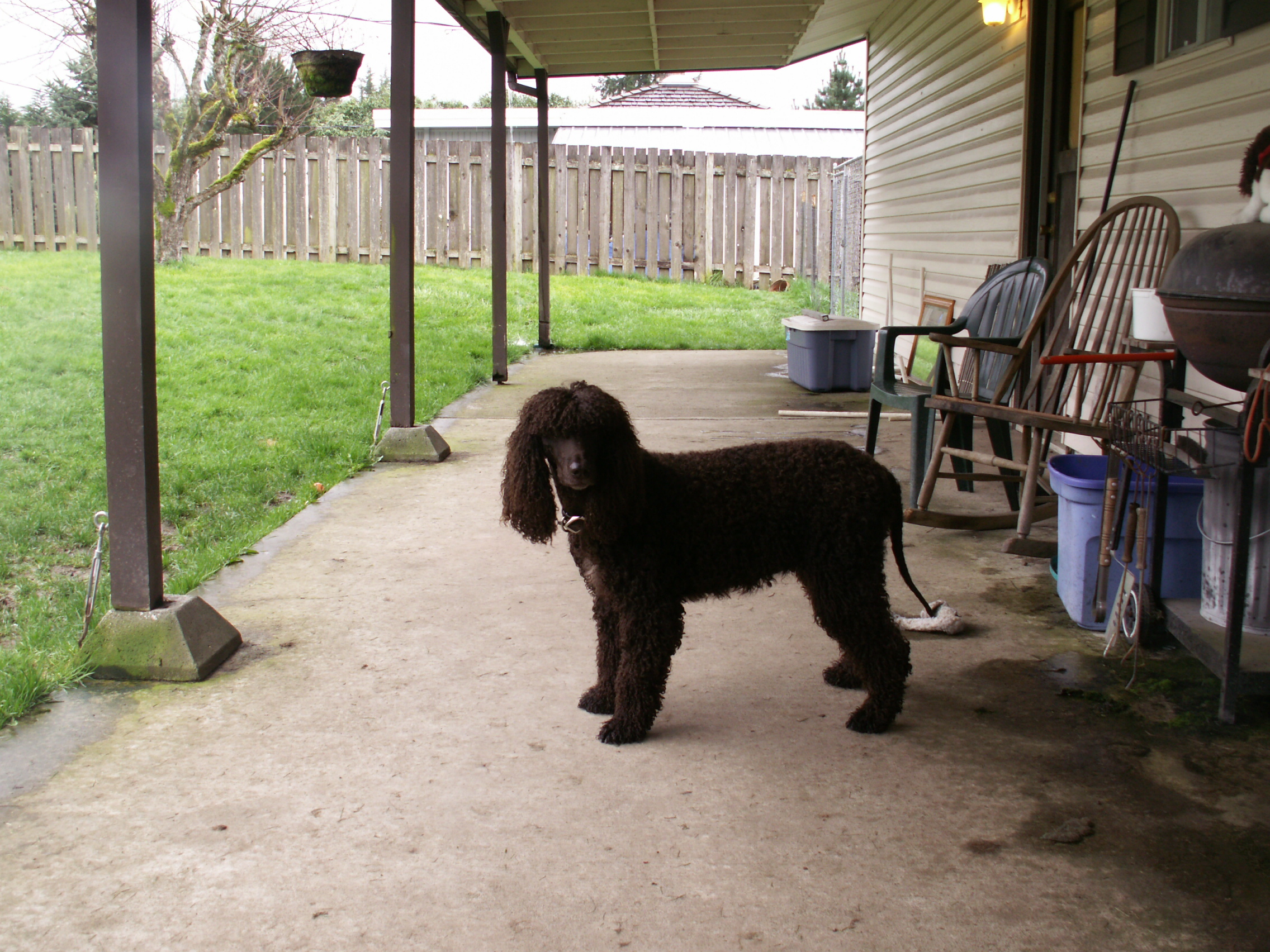
• Journey is 6 weeks pregnant with 8-9 puppies (!) and soon she’ll be heading over to Colleen’s to whelp her litter.  But right now, she’s still eager to work despite the fact that she’s becoming quite rotund.  I’m not sure if this picture really illustrates how full Journey’s belly is, but those 8 puppies are certainly taking up some room:

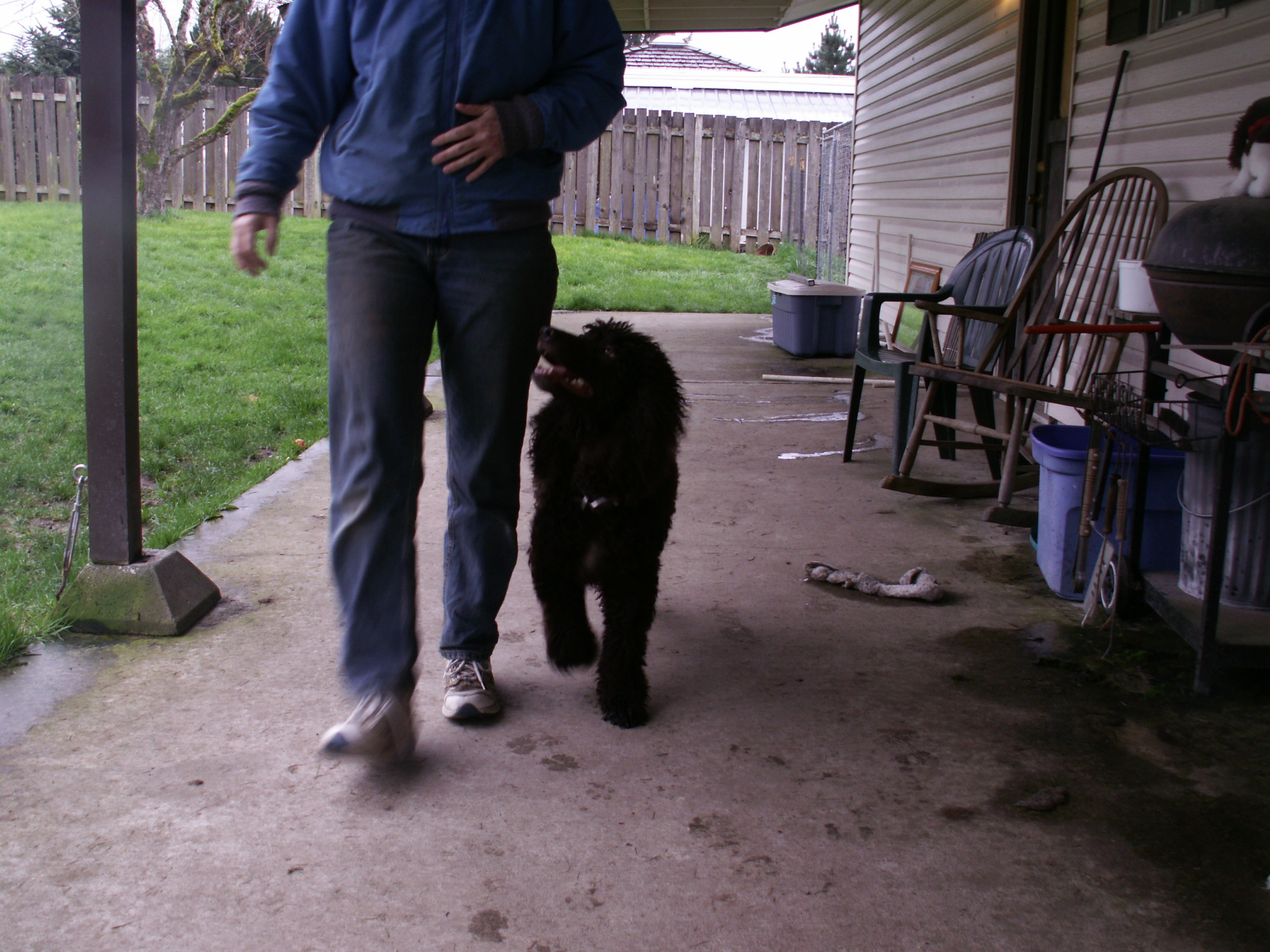
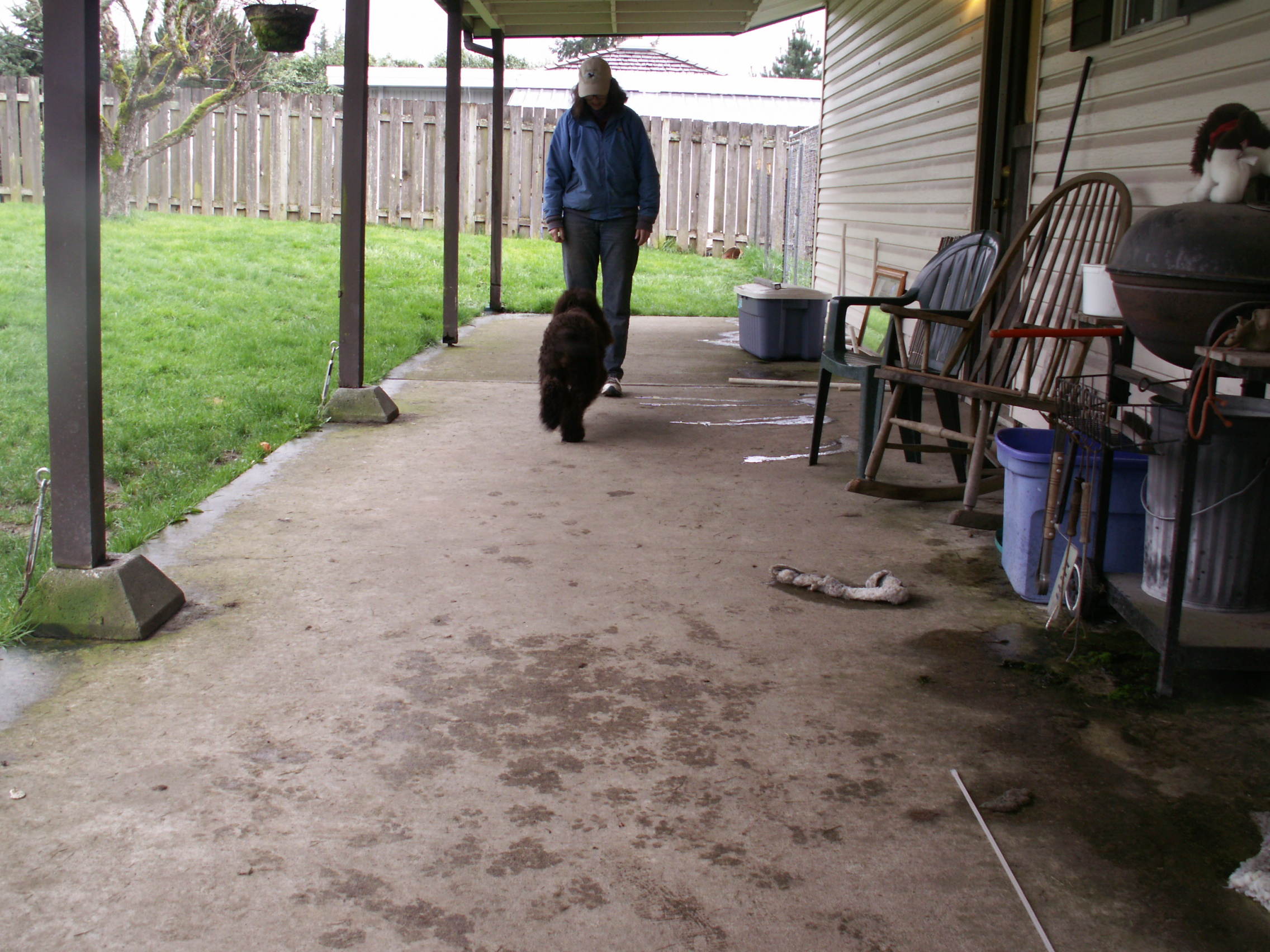
    With her growing puppies, I’m being careful about what kind of work we do.  She’s no longer jumping at all, and in earlier weeks of her pregnancy she was  jumping 8 inch jumps.  We’ve been training the drop-on-recall exercise for the Open ring, but we’ve had to stop that as I worry about her quickly dropping onto her belly.  She’s still doing stationary drops, although that will probably end soon too.  Despite the awkwardness of her belly and added weight, she’s still heeling happily:

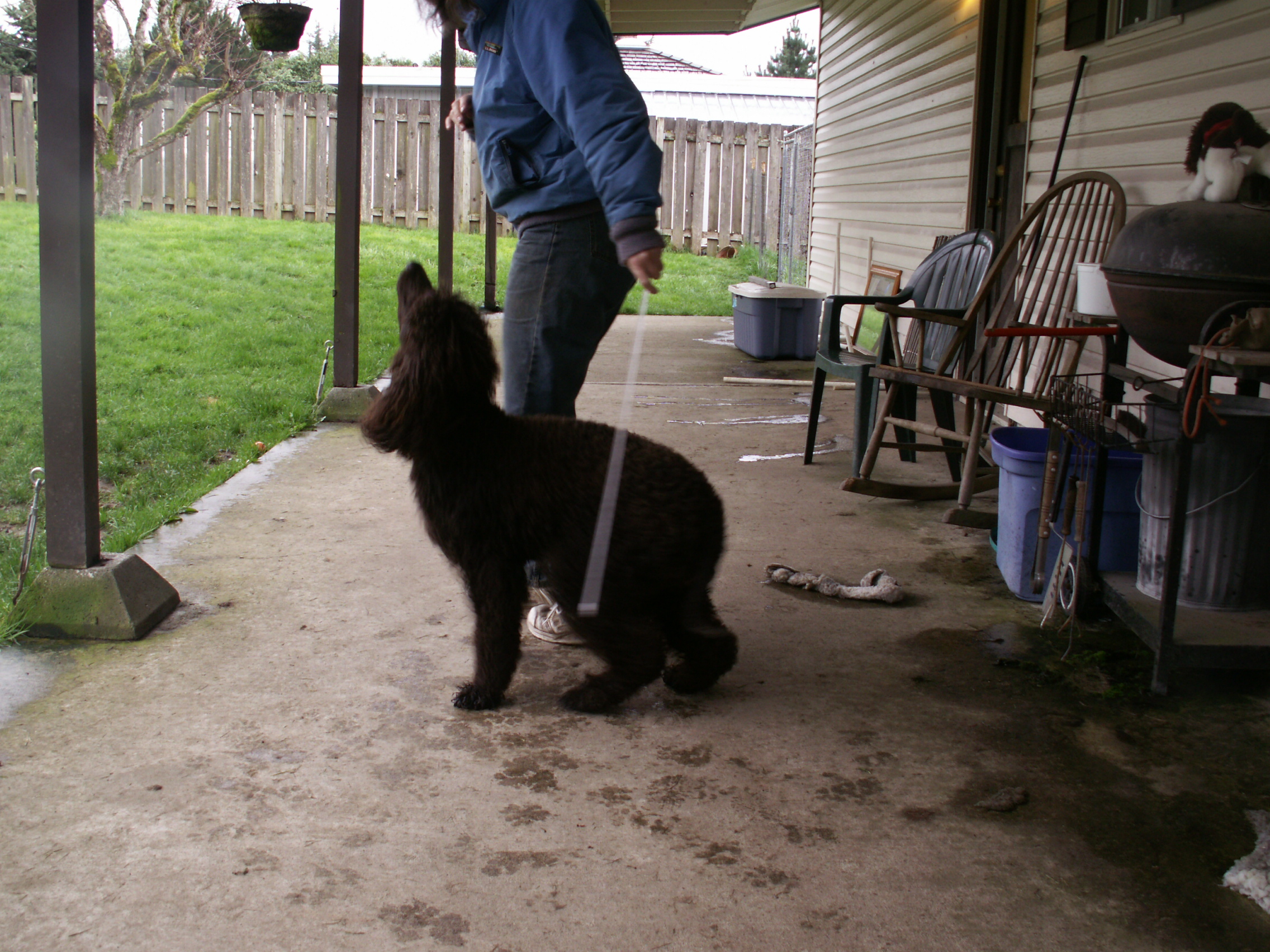
    In general we’re doing more stationary exercises that are low impact and easy on her back and belly.  So I opted for the pivot exercises, where I turn in place either to the left or right, and Journey must turn with me and then sit.  These pivots are necessary for the Utility directed retrieve exercise, and also help solidify heel position.  I thought these would be easy, but Journey is really struggling with moving her expanding belly to the left.   I use a dowel to guide the dog, and you can see Journey here as we begin the pivot:

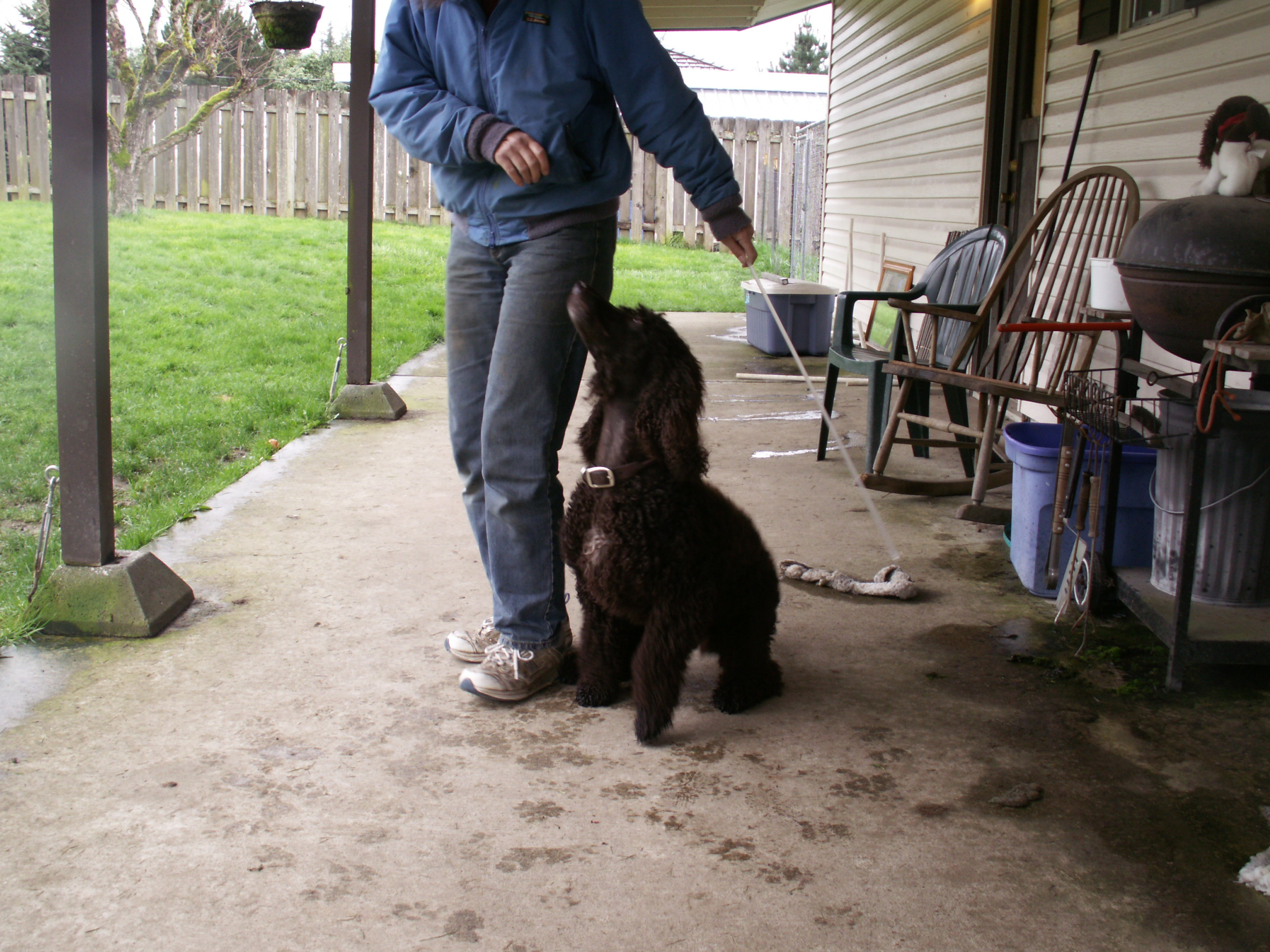
    This pivot to the left, often trained as a “get-it-in,” requires a supple back and coordinated rear end movement.  (Ahem, her’s, not mine!)  Journey’s trying so hard, but right now it’s like manuevering a cruise ship.    Portward ho, maties!

    Whew, we made it.  It’s tough with all that ballast.   We decide to end on an upbeat note with a simple recall. 

    Journey’s desire to work through her pregnancy impresses me so much.  I’m excited to watch her become a mother and am looking forward to many visits with her puppies, but even more I’m looking forward to the time when we can just focus on her promising obedience career.  This is a working girl, no doubt about it. 


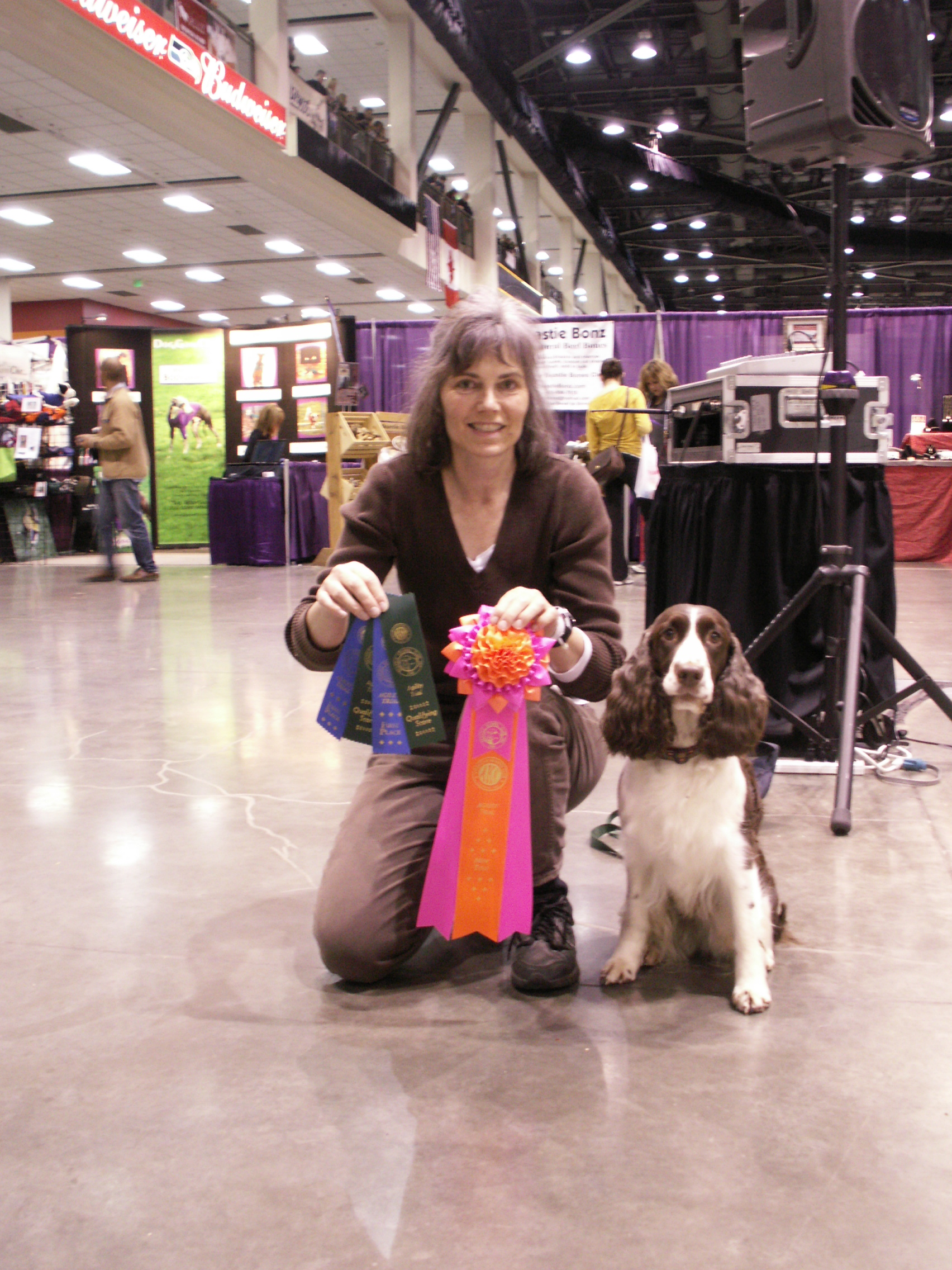
  • Most folks in the dog show/performance world amass boxes full of ribbons won over the years, and we all love to brag about our titles won and placements awarded.  But in the end, it’s really not about those titles and ribbons.  Behind those colorful strips of nylon are the stories: of dreams achieved and dreams revised; months and years of training; tears of frustration, despair and joy; and above all, the relationship with the dog that is profoundly deepened by all these adventures together. 

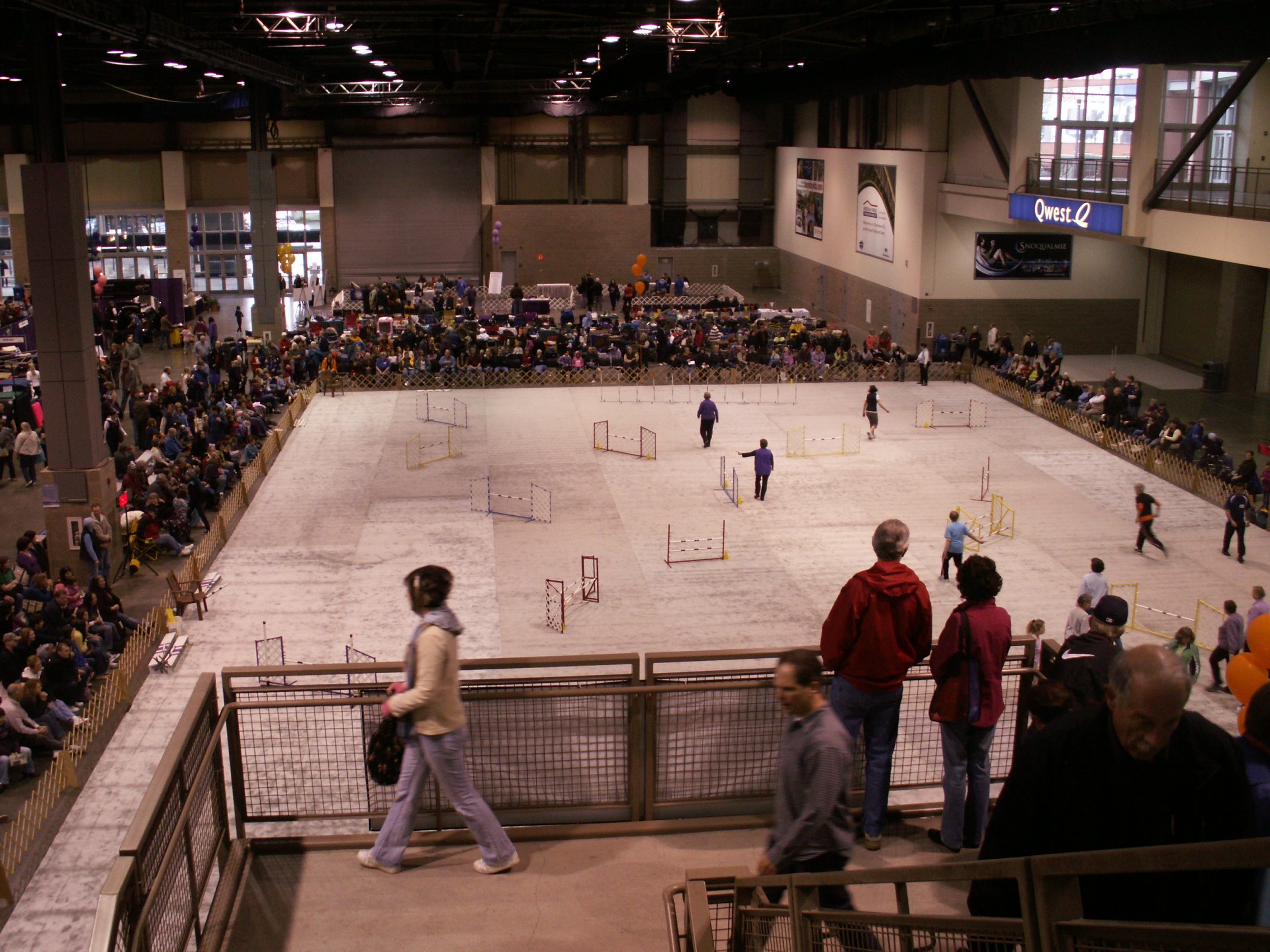
    Once such adventure occurred with me and Rozzie in the agility arena recently.  Ever since I started training her for agility, I dreamed of running her at the Seattle Kennel Club agility trial held every February.  As you can see from the picture below, the crowds are thick and sit in bleachers right outside the ring.  Loudspeakers narrate the agility runs and the enormous hall echoes with the barks and buzz of Seattle’s largest dog show:

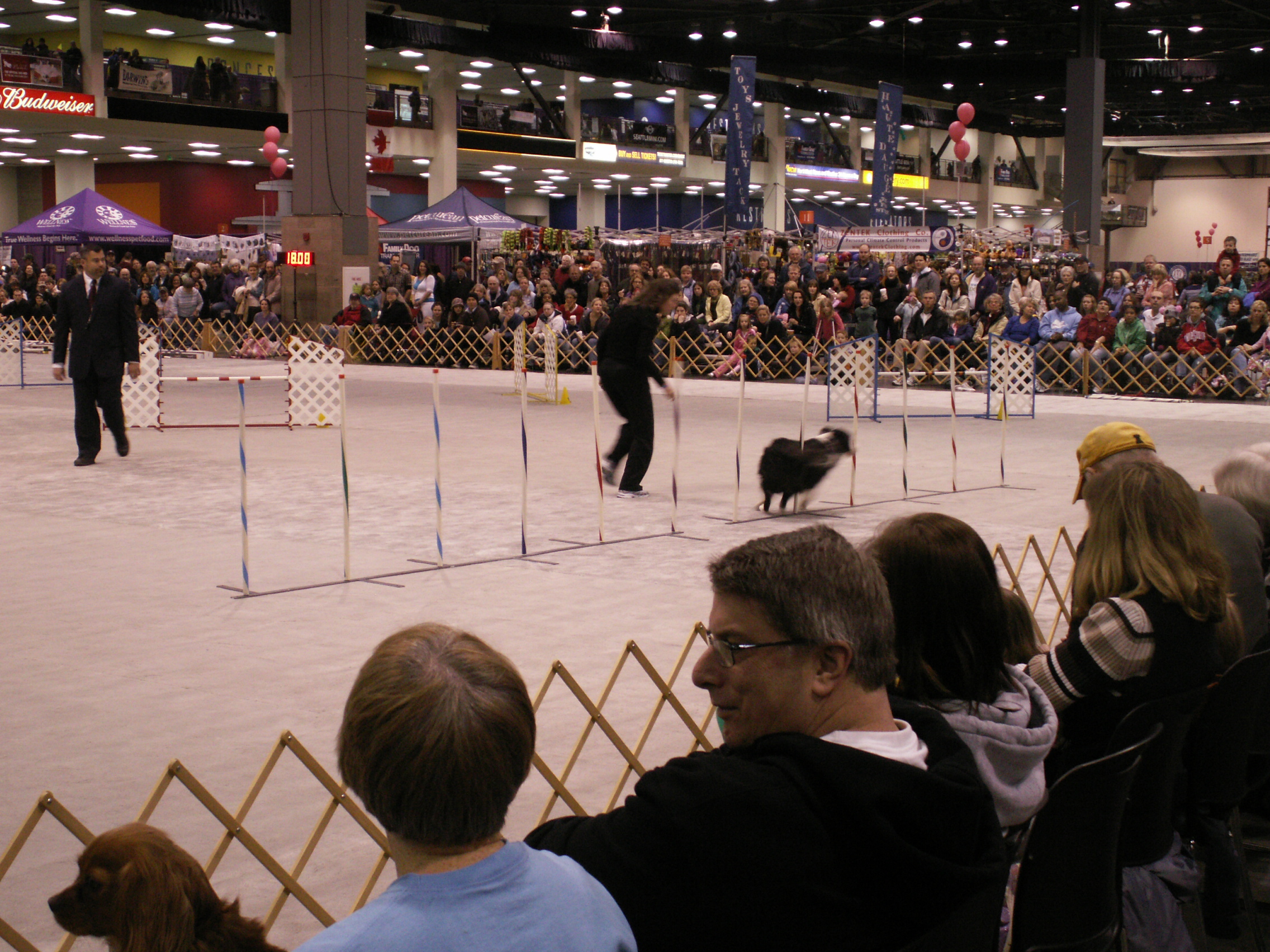
    Here’s another photo at ring level, just to give you more of an idea of how close the crowds are:

    Why did I dream of running Rozzie here?   Just call me a glamour queen at heart, I suppose.  Very few springers are running in agility right now, and I wanted people to enjoy watching her as much as I enjoyed running her.  But I knew the noise level would be quite challenging for Rozzie, as she’s somewhat sound sensitive, and the crowds could frighten her.  So we showed up Saturday morning with me prepared to help her through any scary spots.  Our first run was scary: right as she put her forefoot on the dog walk, a loudspeaker blared. She hopped off and I could not get her back on the obstacle.  The judge whistled us off the course, but fortunately allowed us to run a few jumps on the way out so we could finish positively.

    From there, I was fully prepared for a tough weekend where Rozzie would simply work on her sound sensitivity.  But she stunned me with her ability to recover: her Saturday afternoon run was a “jumpers class” comprised of only jumps, weaves and tunnels, and she ran it “clean” (no mistakes) for 1st place!   The next morning we again faced the dreaded dogwalk, and I had no sweeter sight all weekend than her confident mounting of the obstacle.  She had one split second of hesitation halfway up, and I got out a “good girl!”  From then on, Rozzie was brilliant, qualifying in all of her runs and winning 1st place in her class each time, which meant we moved up into the Open class on Sunday, the second level in agility. 

    So we got it all at the Seattle Kennel Club: ribbons and titles.  But the memory of that weekend is all about Rozzie overcoming her fears far more rapidly than I could have hoped for.  She gave me my dream of running an adorable and very biddable springer spaniel in front of the crowds, and she gained a huge boost in confidence and focus in a challenging venue.  Way to go, my Rozzie girl!

     Ahem.  Now I must confess, there are times when it is all about the ribbons.  Or at least they take on greater significance than usual.  The very next weekend, my gordon setter puppy ran in her very first field trial, a puppy stake with 10 entries.  This is good enough for 2 points towards a field championship.  However, with this being Gael’s very first trial, my only goal was to keep her running forward and not getting scared by the judges on horseback. But lo and behold, Gael ran beautifully and won the stake!  Believe me, getting that ribbon was a wonderful moment:

    Gael is looking a bit put out here as I’m requiring her to sit when she’d much rather be playing with the english setter on stakeout directly to her left.  She just doesn’t understand what the fuss is all about.  But the ribbon hangs proudly on my refrigerator, and will be there for some time.:-)

  • As I mentioned in an earlier post, Journey the Irish Water Spaniel, is happily back with us for additional obedience training.  I’m stunned to report that she has learned her scent discrimination articles in slightly over one month.  Journey arrived here in early December; she’s now at the stage where she is selecting the article I’ve scented without any additional aids.  (Earlier posts on “scent work” can show you earlier training stages of this exercise, as well as the finished exercise in the ring.) In the video that follows, you will see that Journey has all the basics down.  We’re not yet at the correct number of articles she has to choose from in the ring (4 metal and 4 leather articles), and I do give her some encouragement once she’s indicated the right metal article.  We also need to add in the “flying send” portion of the exercise.    But Journey has mastered the hard part, which is choosing my scent out of a pile of similarly shaped objects:

    To give you some perspective on how quickly she’s learned this exercise, my three previous UD-titled dogs (springers and a Gordon setter) took over 6 months of intensive work to learn this, and some preparatory puppy play-training with the articles before that.  Reardon is slightly ahead of Journey on this exercise and has been working intensively on them since the summer, although he’s been exposed to this exercise for much longer.  Journey’s progress on this difficult exercise is truly astounding. 

    However, not all training is this easy.  Here’s a video taken today as well, showing Journey’s difficulties with learning directed jumping.  This is a portion of a more complex utility exercise, where the dog is sent from the handler’s side to the opposite end of the ring, and then directed to one jump or another.  As you’ll see, after one month of working on this exercise, Journey is having a tough time getting the idea.  Finally we take a step backwards, and I put back in the gate that stops Journey from running right to me.  Whenever a dog is having trouble, there’s no shame in stepping backwards to where she’ll be successful.  We’ll use the gates for a few weeks, and then see if she’s getting the idea.

    My instructor tells me that the Irish Water Spaniels she’s helped train have all had trouble with this exercise.  As retrievers, it’s so hard-wired in them to come directly back to the handler.  Plus Journey has had 6-9 months of retriever training, where she’s been trained to return directly.  No wonder this exercise is tough for her!   We’ll just keep plugging away until she gets it.   Note that at this stage of learning, I’m really not correcting her for making mistakes.  I’m just not responding.   If I corrected her at this point when she doesn’t understand the exercise, I have no way of bridging the “wrong” answer to the “right” answer, and the last thing I want to do is discourage her attitude.  I could dig a real hole for us if I got frustrated or negative.  Instead, Journey’s tail keeps wagging through the entire rather methodical exercise. 

    When I watch this, I can see how slowly I’m moving.  How boring–but it was just so darn cold!  Next time I’ll have to be a little more fun.  On the other hand, I can’t be too fun, since Journey needs to keep thinking through this.  It’s always a balance between having fun and maintaining mental intensity.

  • To you, a tennis ball might be a lowly object, a cheap amalgamation of rubber and fuzz, easily substituted by an exact replica and easily discarded.  But to me, a tennis ball keeps chaos at bay.  A house without a tennis ball is a house with a raging Gordon Setter puppy mouth, happy to fill itself with any chewable or non-chewable object: table ends, underwear, kleenex (preferably used), tea bag remnants, any kitchen item including metal forks and knives, student papers, notebooks, and so on. 

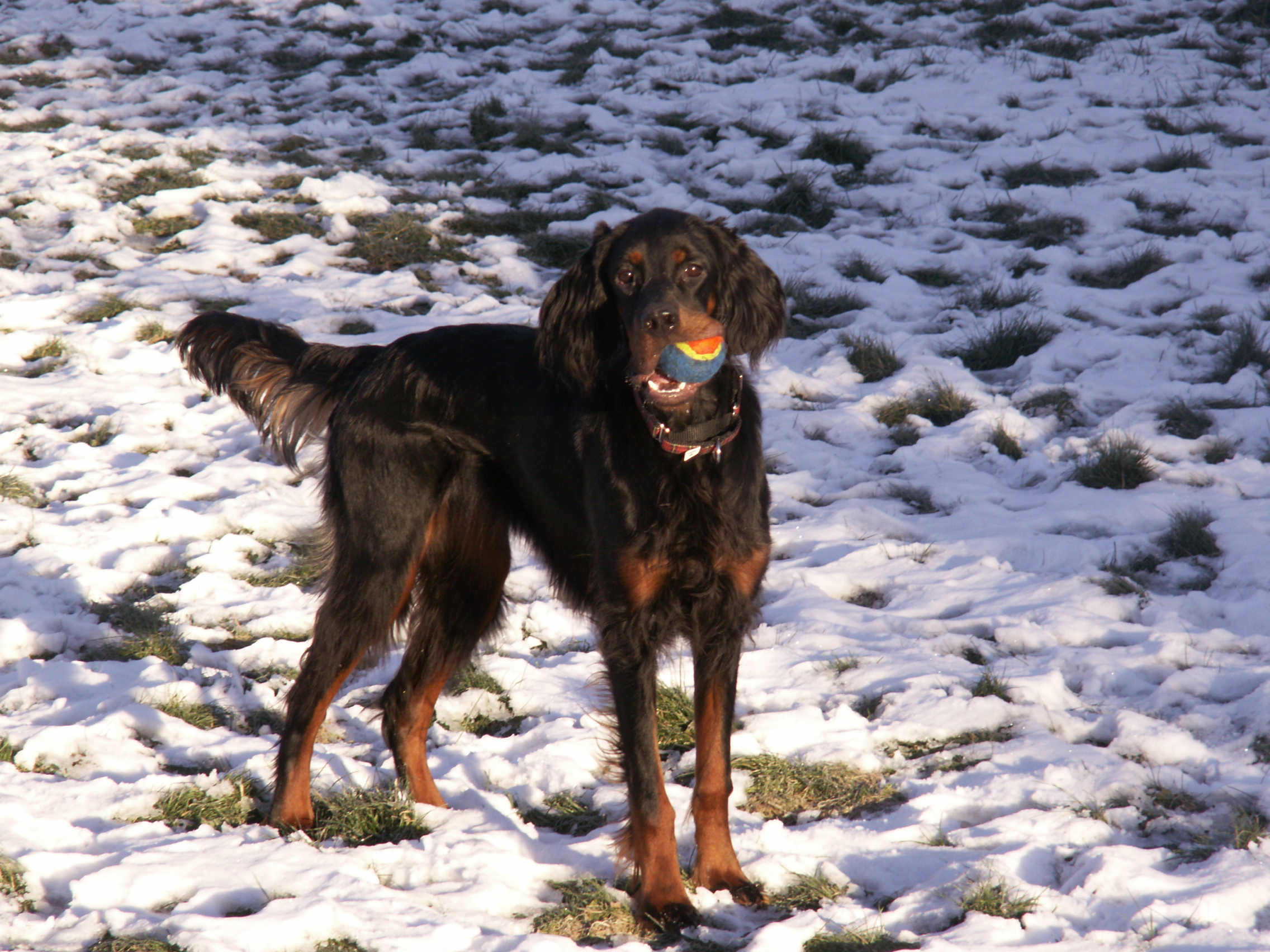
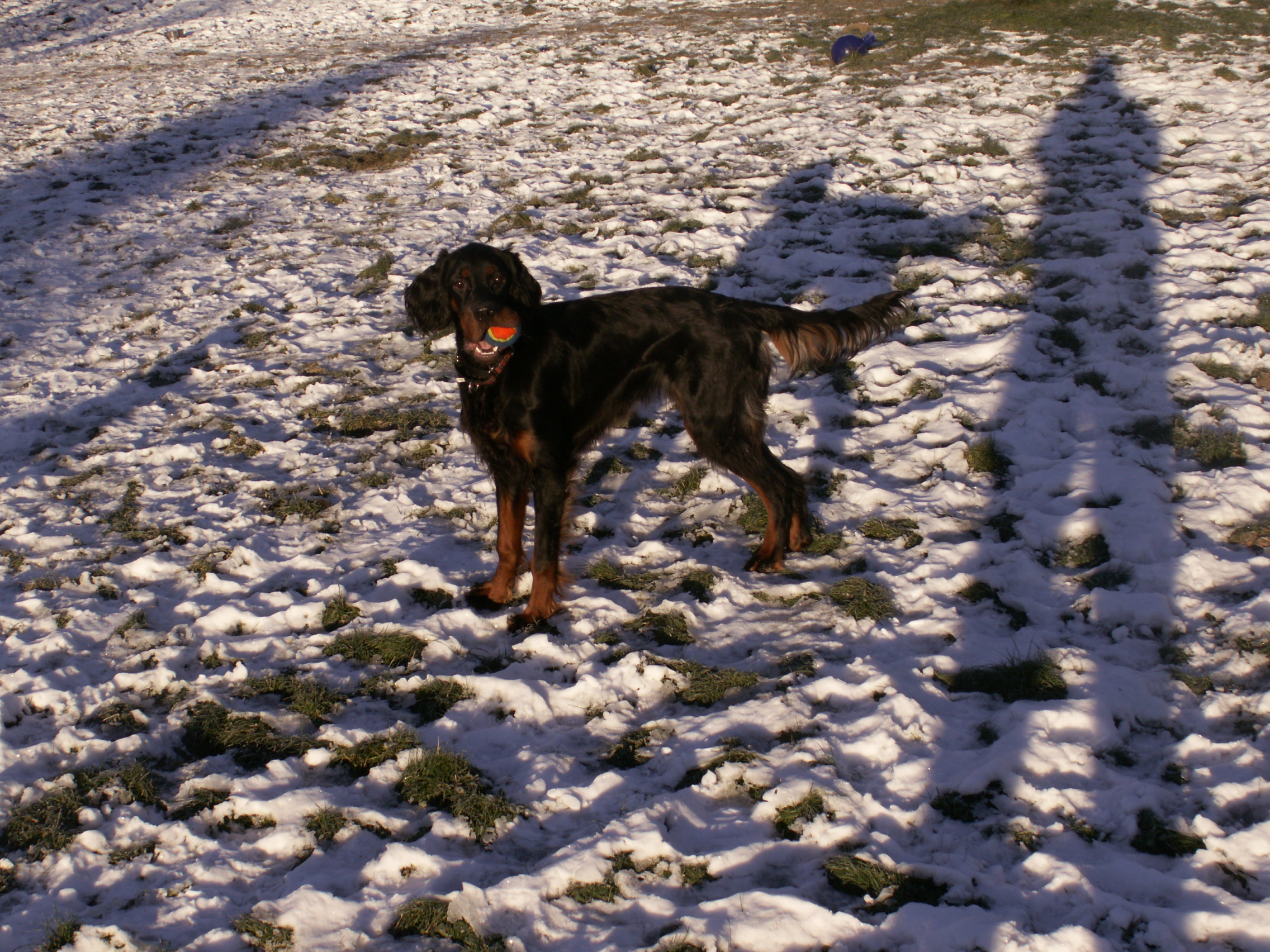
    Thankfully I’ve found that the lowly tennis ball is a wonderful substitute for Gael’s need to chew.  Once her mouth is full of rubber fuzz, she seems content to use her energy in other ways:

    These “other ways” usually consist of running in huge circles and playing keep away from the other dogs, since Rozzie is also a tennis ball fanatic:

    The greatest value of the tennis ball comes in the evening around 7pm, which I’ve come to see at Gael’s witching hour.   When I’m just settling down to dinner and a relaxing time watching TV or reading a book, Gael is winding up for a final harrah of the day.  A tennis ball in the house and a final run in the pasture seem to make this last burst of setter energy liveable.  Without these two strategies, I couldn’t imagine the state of my house or my mind in this 9th month of Gael’s existence. 

  • Our English Springer Spaniel National was held in Albany, Oregon this year in October.  We’ve been training this past year to get the younger springers ready for this event, as the National rotates around the country and so is not always nearby for us to attend.  I was thrilled with the performances of both Rozzie and Reardon, who competed in multiple events at the novice and pre-novice level in obedience and Rozzie in agility.  They amassed a wonderful record of qualifying 9 out of 10 events, and placing 1st or 2nd in all of those qualifying events.  Most importantly, they enjoyed these first attempts in the competition ring, and maintained a great attitude all week. 

    Here’s Rozzie in her second rally round.  There are a few bloopers in attention; she was fading a bit at this point in the afternoon, after already competing in the morning.  Fortunately rally allows the handler to give extra help.  It was still a very solid performance for this novice girl:

    Next is Reardon competing in another class called Beginner Novice, a new pre-novice class introduced by the AKC recently.  It eliminates the off-lead heeling and the group sit and down stays, with some other novice exercises simplified.  I think this is an excellent addition to the titling classes, and a great way to get a very green dog in the ring.

    This next year Rozzie and Reardon will move on to the regular novice classes in obedience.  This was a great first experience for them.

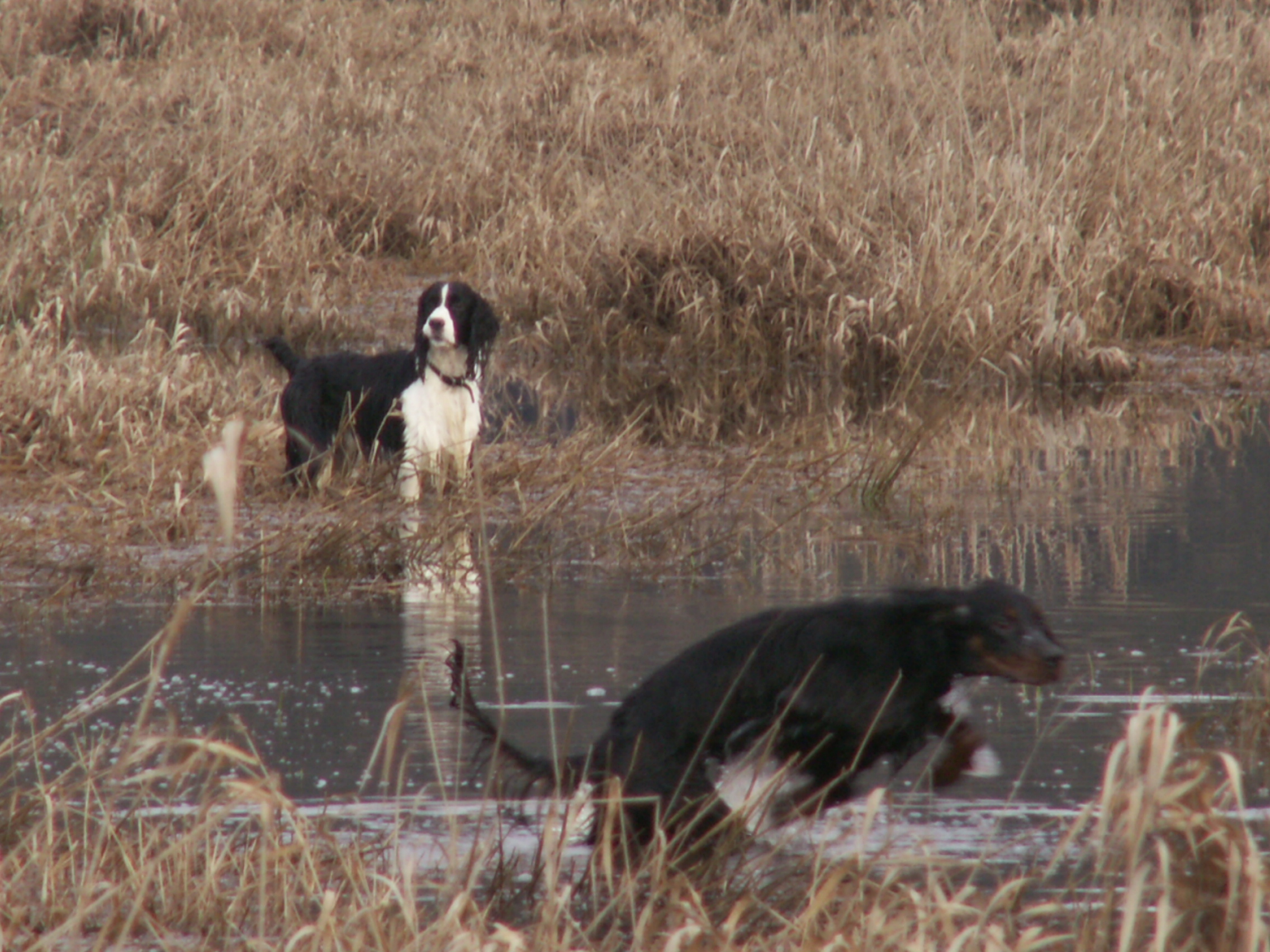
  • It seems appropriate to re-start this blog the way it began a year ago: with a Christmas visit to a nearby wildlife recreation area for a dog run.  Cherry Valley is much wetter than last year, but still a joy for some muddy, wet dogs:

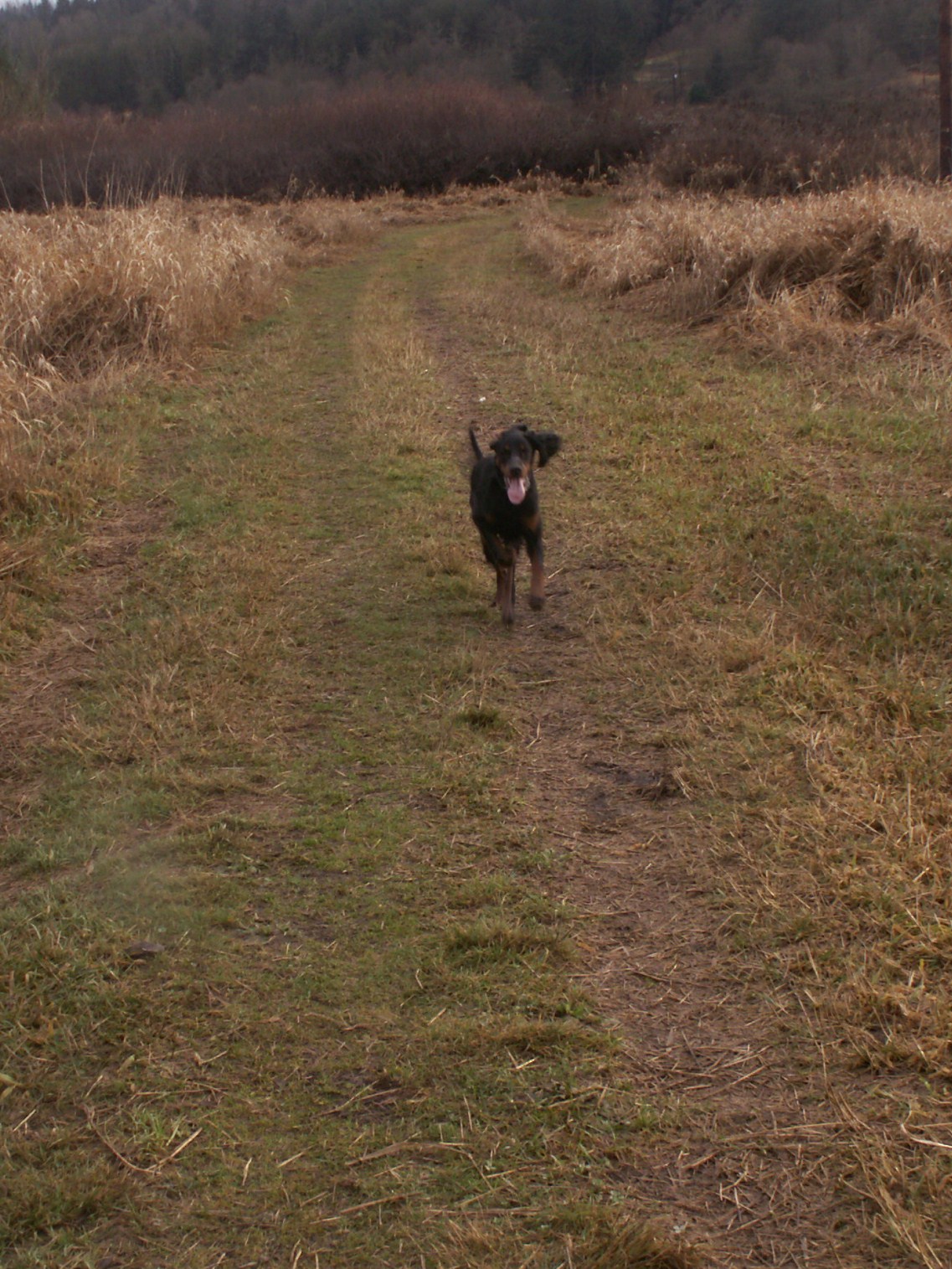
    This trip is also Gael’s first free run in a wildlife area.   Before letting her loose and keeping in mind her setter’s need to run, I first made sure we had a good recall on our property.  I’m happy to report that at 8 months old she is quite willing to respond to my come command and check in for cookies:

    Kani spent the entire time hunting like her old self.  This has been a worrisome year of health issues with her, that are thankfully now identified and treatable.  I have high hopes that this will be her year in the obedience ring.  Here’s a brief moment where she slows down to see where I’m at:

    At last we head home for some Christmas music and knuckle bones for all the dogs. 

    This has been a tough fall for me, with too much stress at work revolving around state budget cuts, and health concerns with Kani and Reardon that are happily resolving.  On the very bright side, we also spent a week at the ESSFTA National with great results, especially with the younger dogs Rozzie and Reardon (more on that in another post).  Gael is metamorphosing from an awkward, gawky demon-unleashed-from-hell to a pretty young girl with some glimpses of obedience.  On an even brighter side, Journey, the talented Irish Water Spaniel, is with us again for training in Open and Utility.   While I sometimes feel overwhelmed with all the demands of training, exercising and spending time with five dogs, I’m thrilled to have Journey back in my life.  I wouldn’t change a thing. 

    Merry Christmas and here’s to a wonderful 2011!

  • I’ve been tracking with Reardon off and on since he was a puppy, and I’ve been very impressed with how it educated his nose.  Now Gael is joining him, and we have some deadlines approaching: the English Springer Spaniel National, which is in Oregon in October, offers a tracking test, and there are several tests coming up regionally in the fall and late winter. 

    In AKC, the basic tracking title is the TD (tracking dog), where the dog tracks human scent for approximately 400 yards.  The track has to be aged at least 30 minutes, with multiple turns and some changes in terrain.  The dog must indicate a glove dropped at the end of the track.

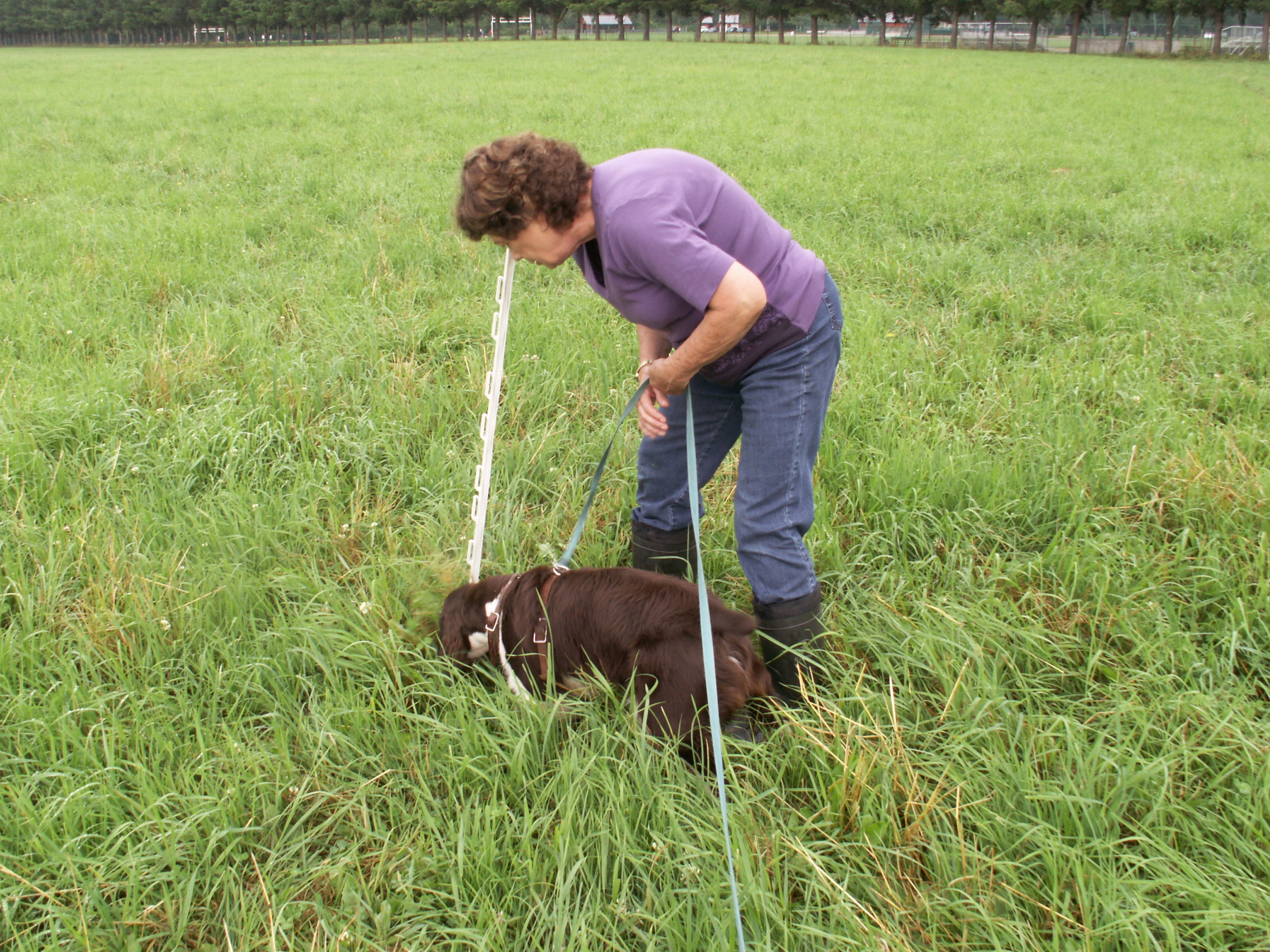
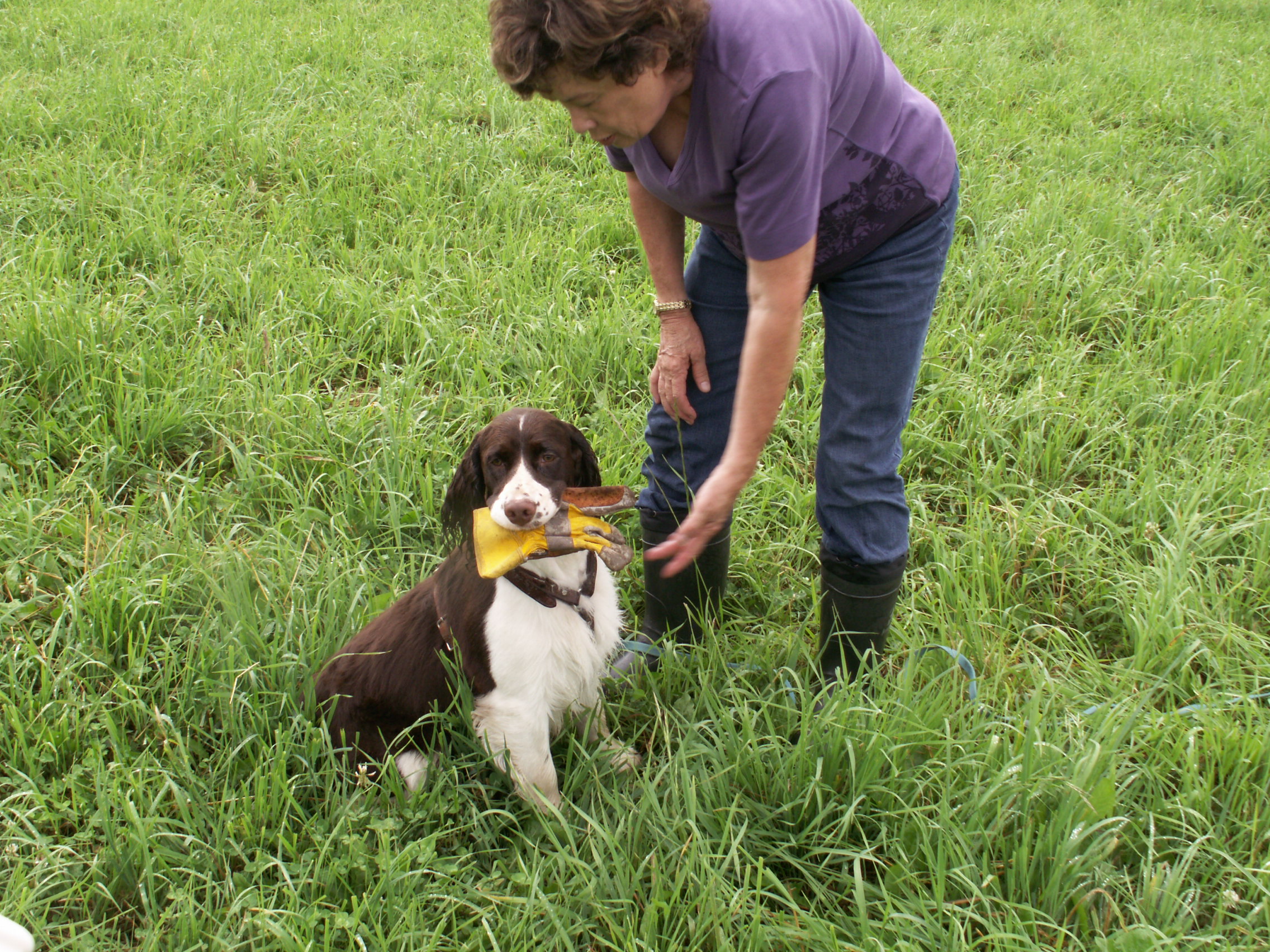
    I’m joining my good friend Lynn Winchester of Alynn Springers two or three times a week now to get our dogs ready.  Her dog is “Indy,” a 10-month old springer.  He’s been tracking only a few weeks, but showing excellent aptitude and eagerness.  Here are Indy and Lynn at the startline, which is always marked with a pole and a first glove:
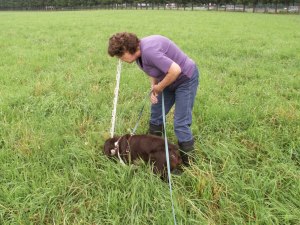
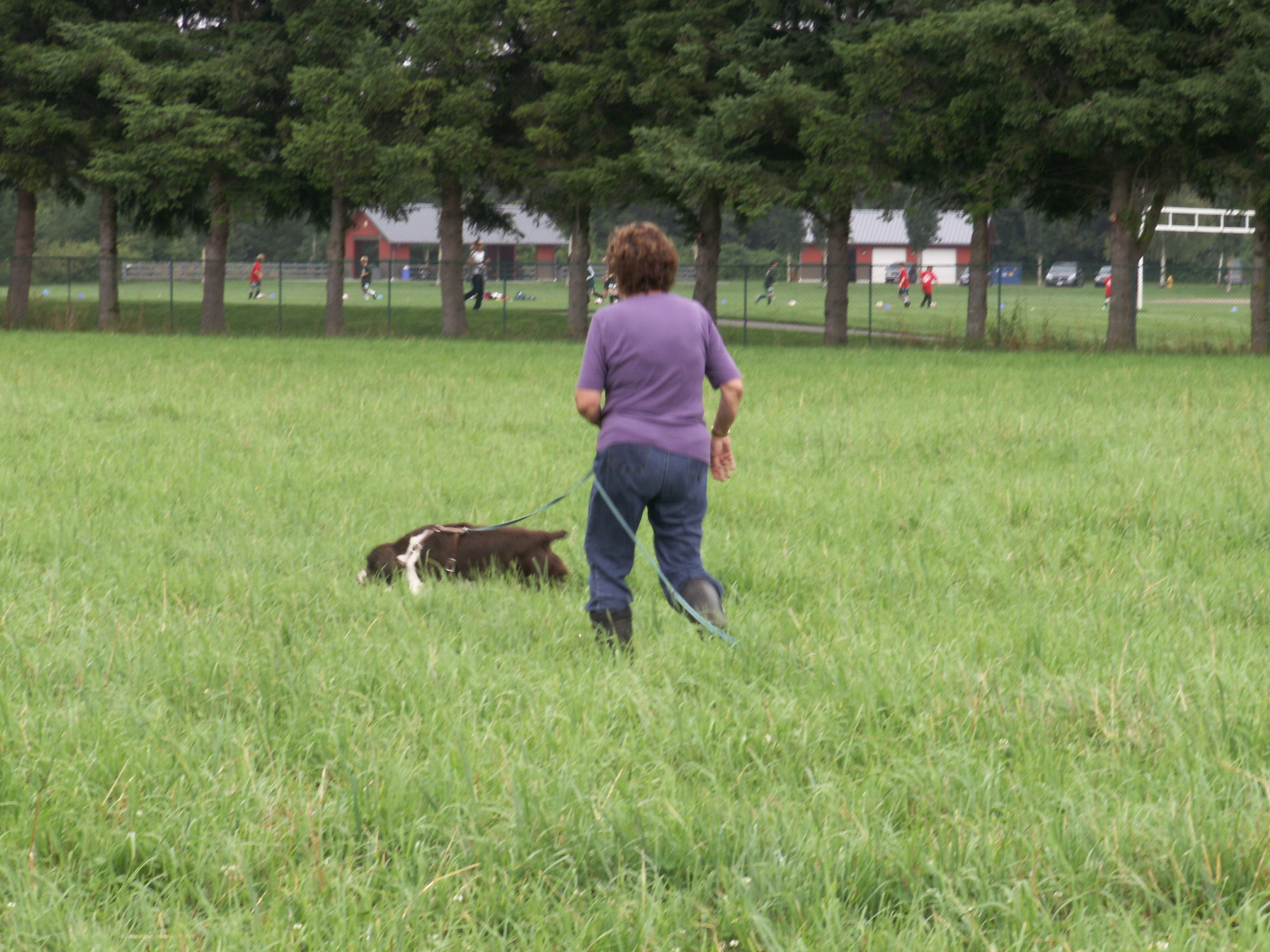
    At this beginning stage, the track is laid with hot dog pieces dropped along our footsteps. That way the dog is rewarded for following human scent.  At the time of this photo shooting, we are laying 3 tracks for Indy right in a row, with the first one at 35 yards, the second 50 yards, and the third 75 yards.  They are all straight tracks, no turns.  (The following week, this week, we introduced turns and Indy handled them well.)  Here’s Indy taking off on one of his tracks:
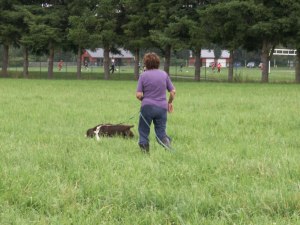
    Indy finds his glove!  We encourage the dogs to play with the glove and retrieve it afterwards, since at the test, they have to show some clear indication of the glove.  They can’t just track past it:

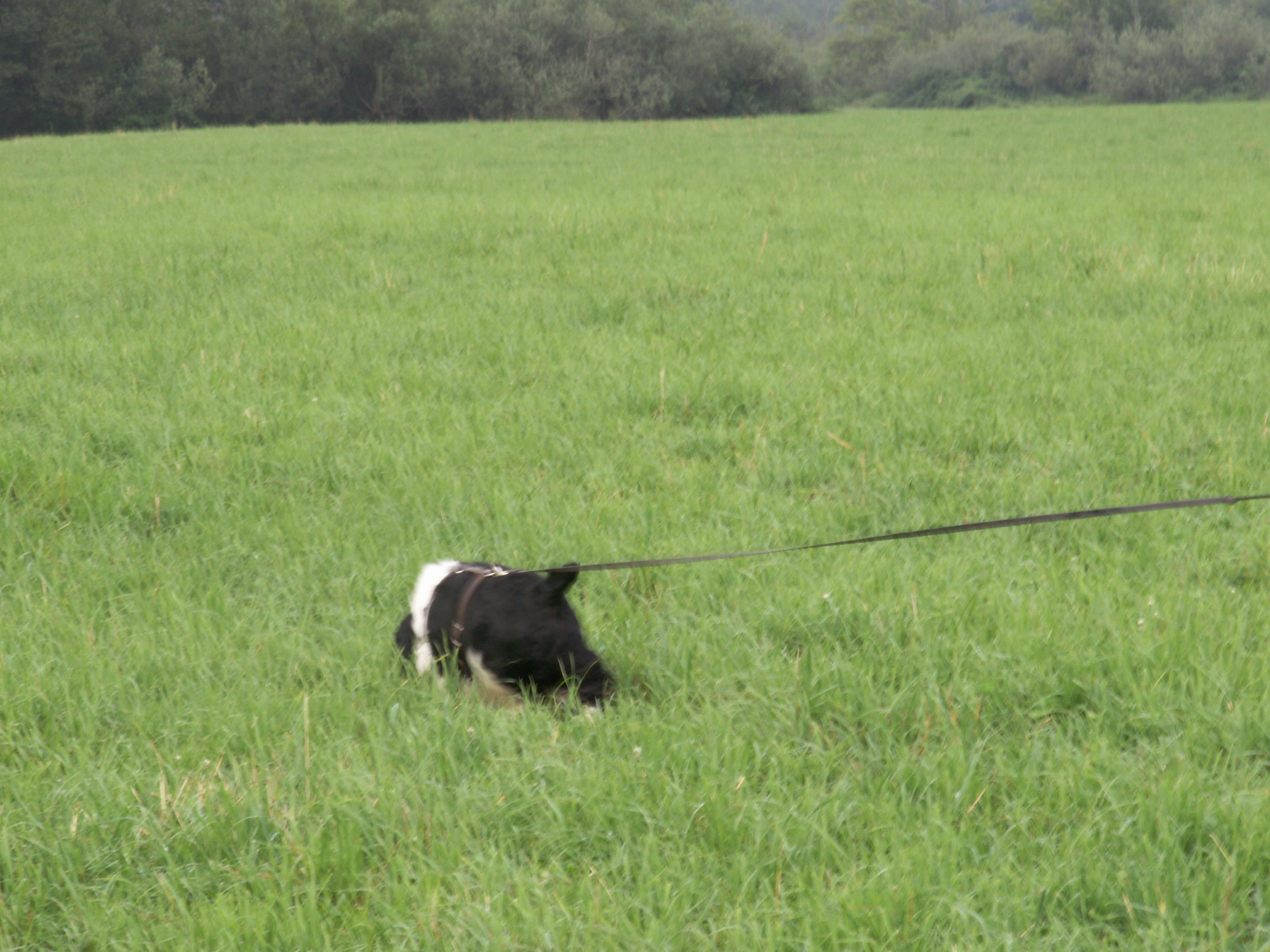
    Now it’s Reardon’s turn.  He’s been tracking for longer, so his track is more advanced.   Lynn has been laying his track with 3-5 turns in it.  This track was a bit over 200 yards, and it was aged over 1/2 hour:

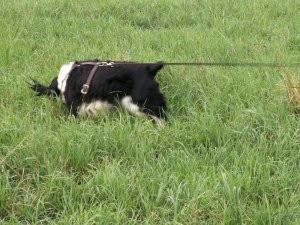
    Note that the line is taut.  Unlike obedience work where the leash should be loose, in tracking the dog is actually pulling you along the track.  The taut line is a means of communication between you and the dog, to let him know you’re there.  Also in training, if he goes off the track, you let the line go slack and raise it up to let him know he’s off the correct scent.  In an actual AKC test, you must be 20 feet behind the dog.  Most of us use lines that are 30-50 feet long, and mark that 20-foot spot on the line with a strip of colored tape or a knot.
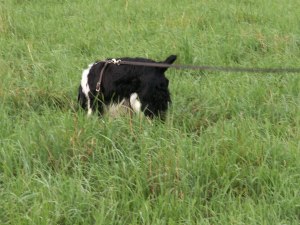
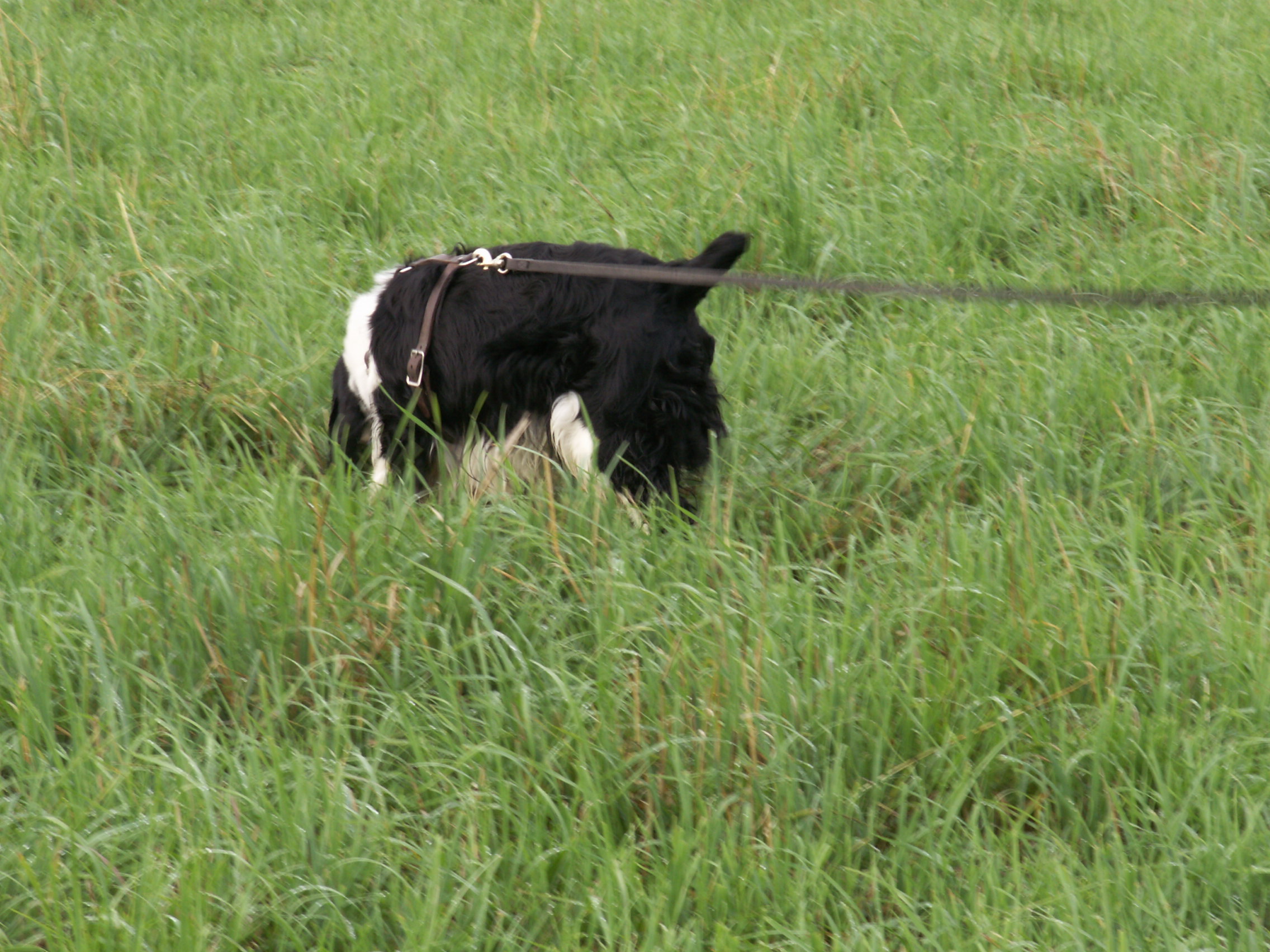
    After the very slight slackness of the line in the above photo, you can see Reardon is now charging and pulling the line taut.  He was hesitating on the scent; when he really pulls on the line, he’s telling me he’s certain and we can move forward with confidence:
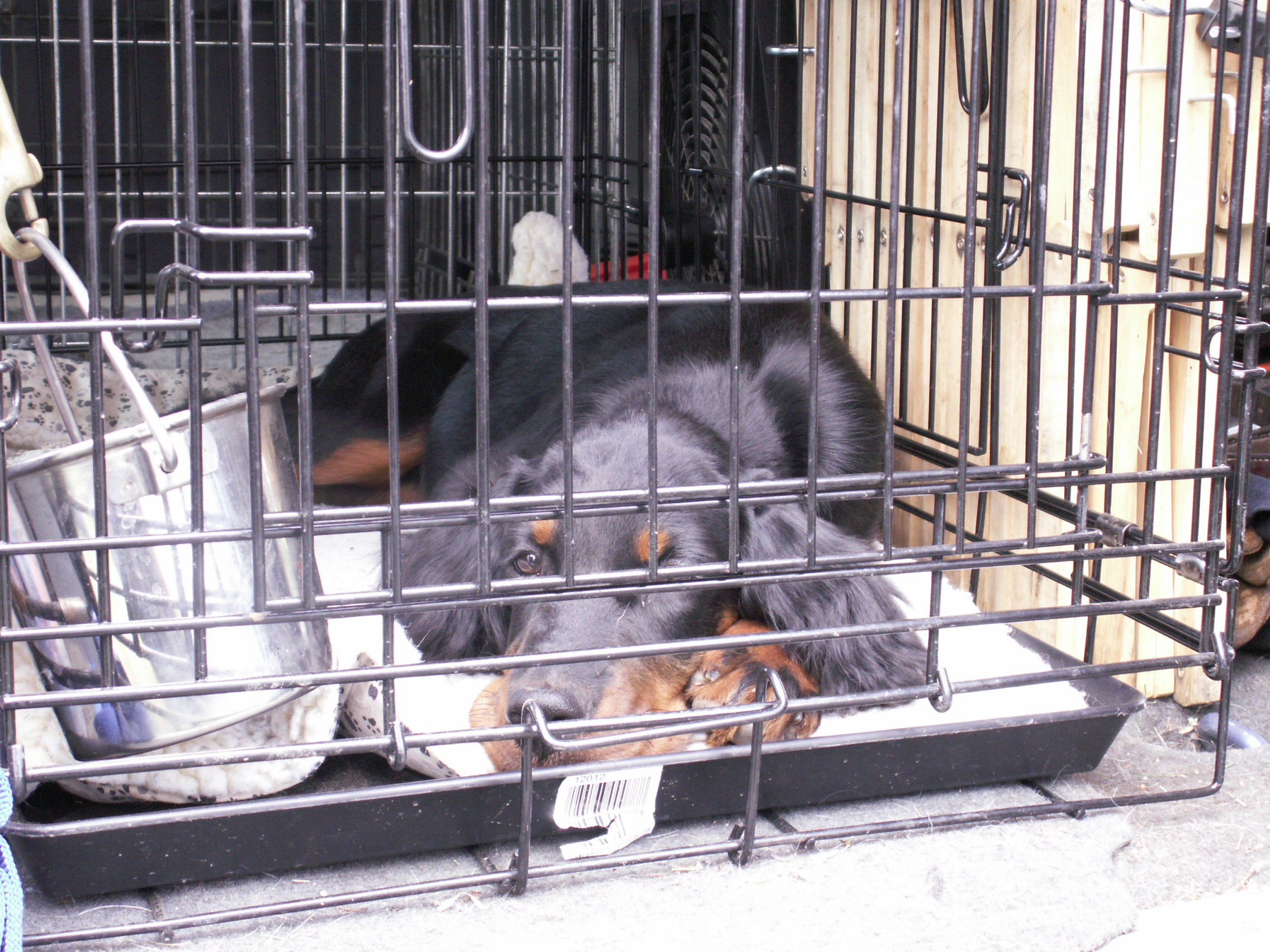
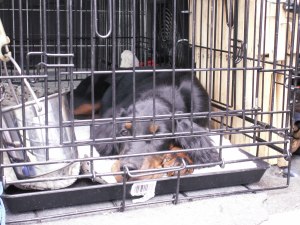
    Meanwhile, a surprisingly patient Gordon Setter puppy is waiting back in the van for her turn.  Gael has to wait until last because, as the baby, her track isn’t being aged yet. 
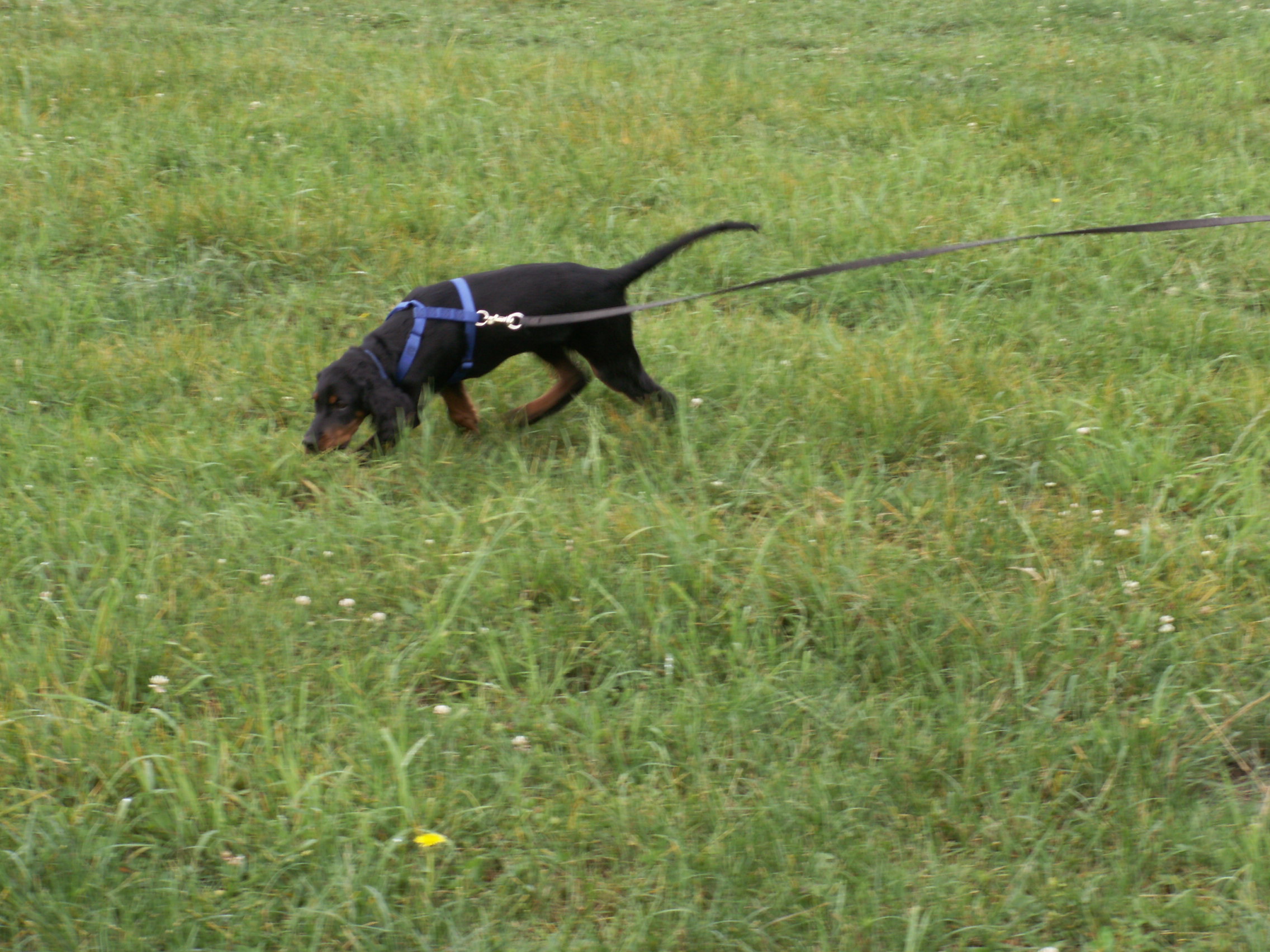
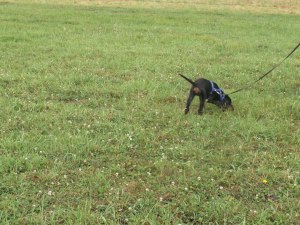
    Now it’s her turn!  You’ll see the line isn’t taut yet.  Gael is gradually gaining confidence, and will begin to truly pull in the next few weeks.  Right now she does a lot of casting about (making circles and veerings off the track) because, according to this Gordon puppy, NO HOT DOG CAN GO UNFOUND.  If nothing else she is determined to find every piece of food we’ve left for her. 

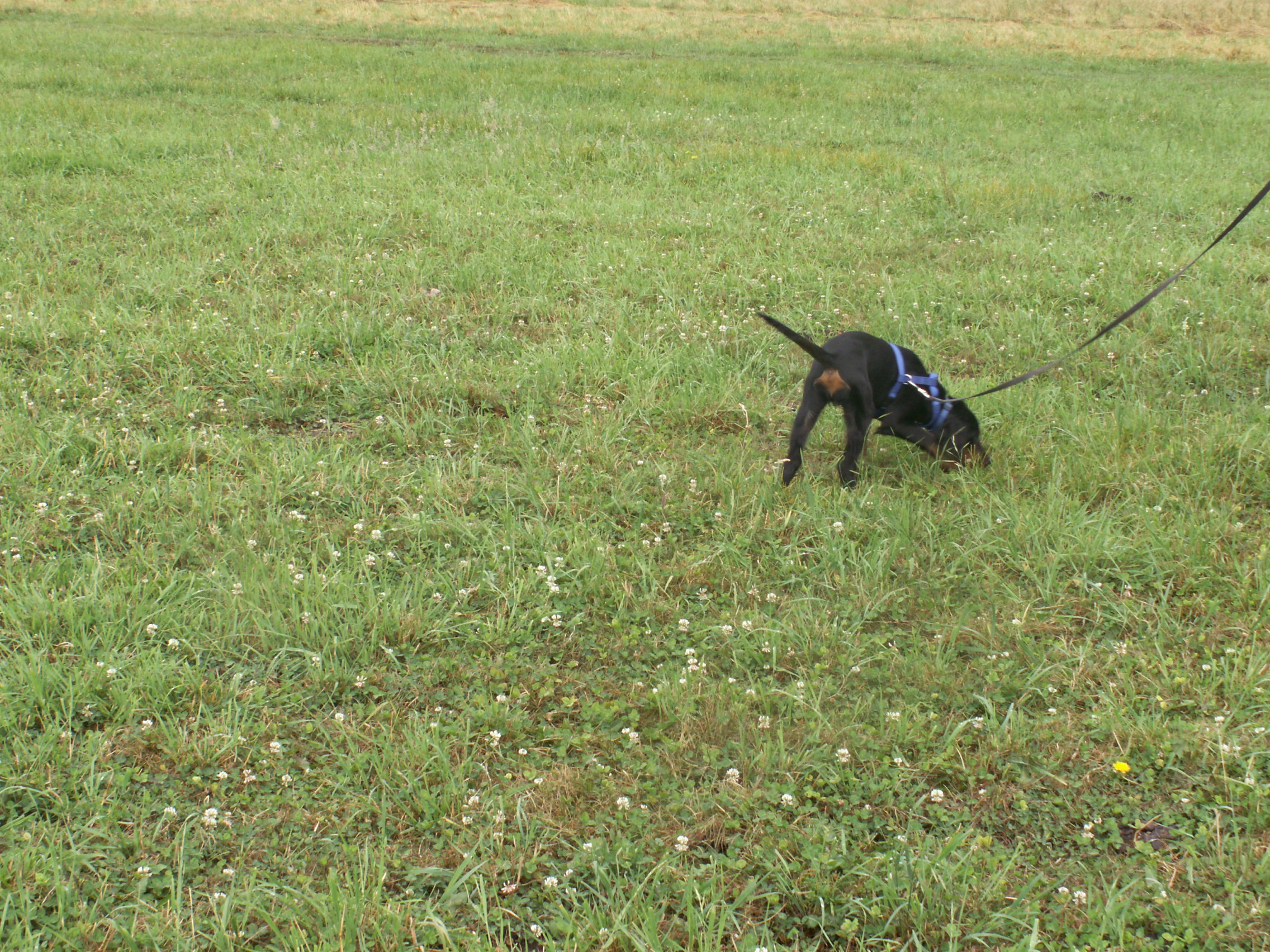
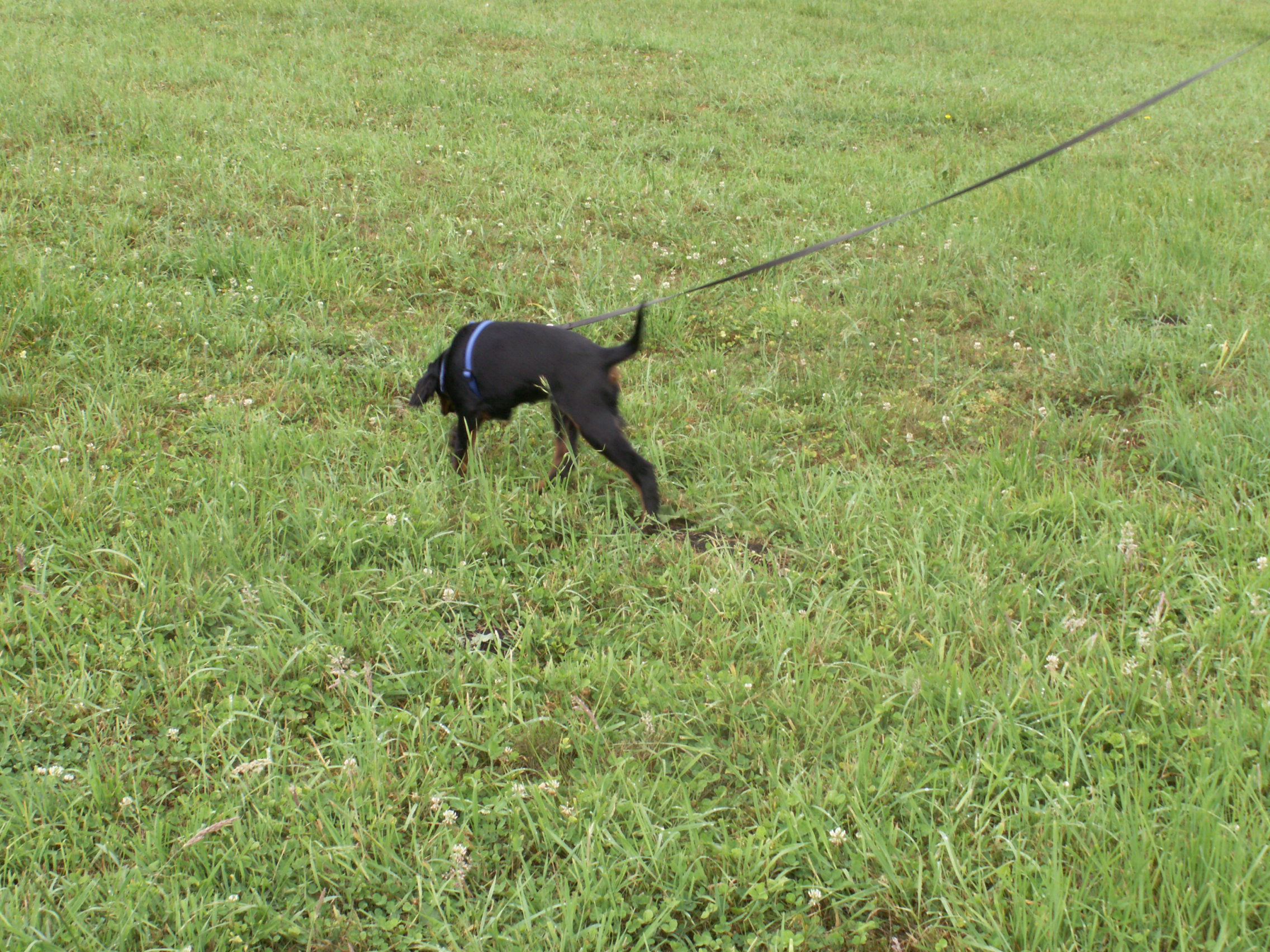
    Here Gael has gone off the track.  Interestingly enough, she’s probably searching for hot dog scent that the wind has blown off the track.  Although it’s best to lay puppy tracks into the wind, on this particular day we had a lot of odd wind currents.  We’d lay the track into the wind, but by the time we ran it, it had turned into a crosswind.  Most likely Gael is working a crosswind here:
    Now she’s back on the track.  Good girl!  Actually we talk very little to them while they’re tracking.  They know when they’re doing it right or not, and talking just distracts them.  Tracking is an activity where “trust your dog” and “let your dog work” are the prominent mantras.
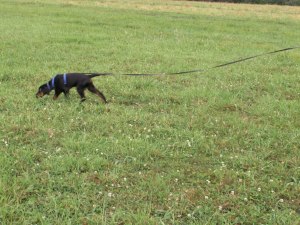
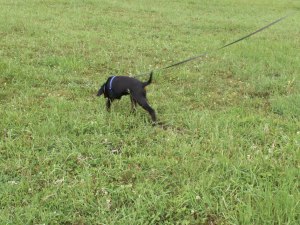
    Here Gael is working confidently.  Note the tighter line.  She’s coming along nicely in her tracking work!
    More tracking reports to come!
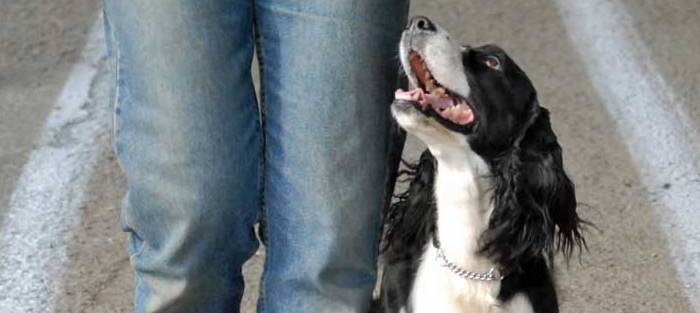
  • When Susan Desilver described Gael’s litter to me over the phone, one of my first questions was, “which puppy likes to carry things around in her mouth?”  What I was looking for were early signs of a natural retrieve.  In my earlier posts about the natural retrieve, I talk about how much it reveals in terms of the dog’s trainability and willingness work as a team player.  I think all sporting breed breeders would benefit from adding the natural retrieve to their puppy testing (if they don’t already).  In my ideal world, breeders would keep the puppy who presents not only the best conformation, but also the best puppy retrieve.  Many, many obedience trainers, including Guide Dogs for the Blind, use the retrieve as the single most significant indicator of temperament in their puppy testing; what if show breeders started to do the same, and selected for the best retrieving as well as the best structure? 

    As I’ve play-trained with Gael these first few weeks, I’ve been thrilled with the signs she shows of natural retrieving.  As the video below shows, she’s not perfect, but she shows many wonderful traits:

    • a high drive to retrieve the object
    • while she’s still learning the best way to pick up objects, she quite sensibly chooses the dowel of the dumbbell rather than the bell
    • an ability to run with the object in her mouth
    • a willingness to come to me with just a bit of coaxing on my part*
    • the willingness to retrieve lots of different objects

    *I’ve had good results with turning away from the puppy on the return so the return becomes a chase game; I also borrow from schutzhund training, where the trainer doesn’t always take the object from dog.  Thus the puppy doesn’t associate coming back with the loss of the object.

  • The most important thing a puppy can learn is how to learn–that learning is fun, that it comes in relationship to a human, and that it’s something she is good at.  After 6 days with me, I’m so impressed at Gael’s attitude, drive and intelligence.  Beyond the socializing I need to give her in the first 16 weeks, showing her that learning and practicing what she’s learned is a central part of her relationship with me.  It’s my job to make it fun and interesting.

    Susan DeSilver, the breeder, warned me that her dogs learn quickly, and sometimes learn things we don’t mean to teach them.  In the clip below, you’ll see that Gael is already responding quickly to some of my commands (after only 4 of these little training sessions during the last week), but she’s also learned that I store the cookies in my back pocket.  Little vixen!

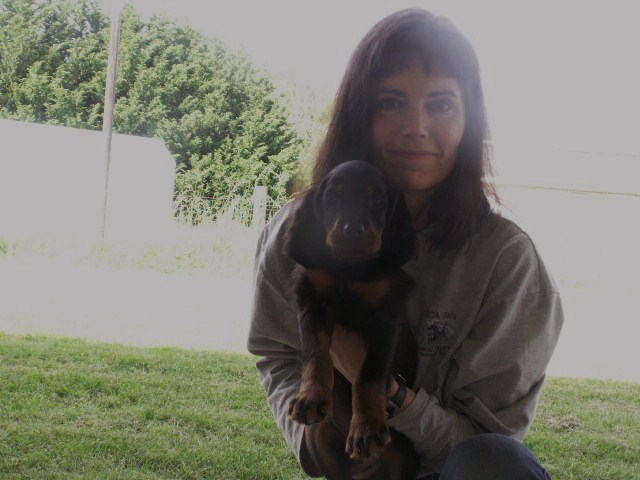
  • I had no plans for another dog.  And not a Gordon Setter.  For months after I lost Vita, I daydreamed of a Gordon puppy, but as my grief eased, my daydreams stopped and life moved on.  Then I caught a phone call from Susan DeSilver, the accomplished and well-respected breeder of Gordon Hill Gordon Setters. Susan breeds and competes with some of the top Dual Champion Gordon Setters in the country.   (“Dual” meaning that the dogs earn championships in both field and the show ring, an accomplishment rare in any breed today.)  A few years ago, I had told Susan that if and when she bred her bitch “Scout” (Dual Champion Indian Sky Gordon Hill Scout), she should give me a call. 

    And this was the call.  It took me a little while to ponder how my life would change  with a Gordon puppy in the household, but in the end I couldn’t turn down a puppy from this bitch or this pedigree.  Scout has everything I’ve ever wanted in a Gordon: drive, intensity, work ethic, and athleticism.  Susan keeps telling me she also has a “wicked” streak, but to me that signals a dog with intelligence and curiosity. 

    Some odd “signs” that added to the mythos of this litter: they were born 20 days to the year that I lost Vita; and while they were in utero, a powerful spring storm passed through Scotland down from the Orkney Islands, cutting off power and closing down roads and businesses for several days. 

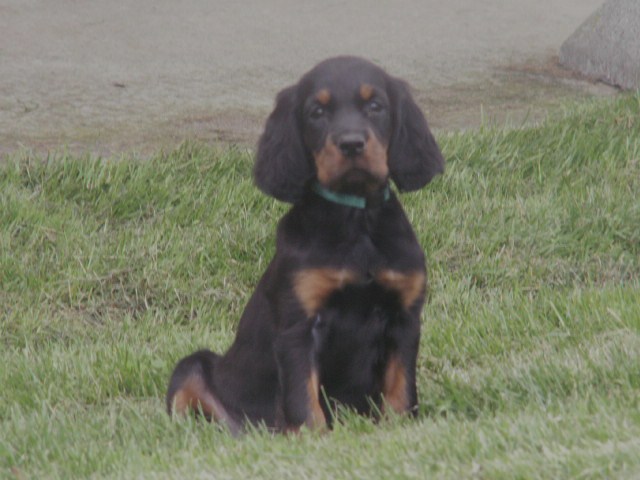
    And so my Gordon girl is named “Spring Storm,” using the Scottish Gaelic word for storm: “Seideadh.”  Her call name is Gael, and her full name is Gordon Hill Spring Seideadh.  Please welcome her: