I’ve been watching the 2012 Olympics much more obsessively than in several years past. I loved them as a child, and for some reason my interest has been re-ignited this year. With my recent focus on the mental aspect of dog performance sports, much of my attention in these Games has been on the sports requiring precise, complex movements, like gymnastics and diving, and the mental performance of these gifted athletes. While I can’t get inside their heads, it’s often clear how mentally prepared (or unprepared) they are for the immense pressures they face in the international spotlight.
Gymnastics drew me the most, and struck me as having many similarities to showing dogs in obedience trials and freestyle. The movements in both sports need to be precise and controlled, and split-second mistakes can cause havoc. To be a really great handler, focus needs to be 100% on the dog and the skill to be performed; to be a great gymnast, focus has to be 100% on the apparatus and the skill to be performed. Recovery after a mistake is crucial; if the handler or gymnast keeps “looking back” in her mind after the mistake, more mistakes start piling up. Instead, the athlete’s mind has to move on immediately to the next skill in the routine and let go of the immediate past.
To me, mental toughness separated the gymnasts on our American team. Mind you, this is NOT a criticism of any of the great athletes on the U.S. gymnastics team; they are superb athletes, with many accomplishments behind them. Just getting to the Olympics is a huge accomplishment. But the ones who were mentally tough made it to the top of the heap and earned medals; the ones who struggled with their mental game wound up disappointed.
In particular it struck me how heavily expectations weighed down many of the gymnasts. Danell Levya and John Orozco had outstanding qualifying rounds in the Olympics trials. I fully expected both of them to shine at the Games. But both of them made significant mistakes on skills they typically handle easily. Orozco in particular made a basic mistake on the pommel horse that dropped him out of any competition. A basic mistake like that, on a skill Orozco normally breezes through, signals a mental mistake, not a physical one. Then Orozco just couldn’t bounce back from that mistake. It haunted him the rest of the week and he could never seem to bounce back to his earlier flawless, fluid level of confidence. Even one of the announcers remarked several times how “tight” Orozco was, and how much that was affecting his performance. I suspect this was an issue of mental toughness, not a physical one.
McKayla Maroney is another example of expectations affecting her mental game. She’s the top female vault gymnast in the world, yet in the competition for the Olympic 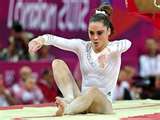 individual vault medal, she blew her landing on a skill she’s done perfectly for months, if not years. Again, I suspect the issue is mental toughness, not physical ability. How much did all those expectations affect her ability to vault freely and unself-consciously?
Again, this is not a criticism of these great performers and athletes, who obviously have a great deal of mental toughness to get as far as they did, and I can really only speculate. But the pressure of the Olympics must be immense, both internally and from their families and coaches. It’s interesting to me that the greatest gymnast of the Games, Gabby Douglas, had a coach well practiced at handling the pressures of Olympic medal competition. Aly Raisman is another interesting story.  Before the Games began, she was not one of the stars of the team. During the intense team competition where she executed a beautiful floor exercise, the announcer pointed out that “nobody’s been talking about Aly Raisman.” In other words, she had not the intense external expectations of some of the other gymnasts. And it was Aly who walked away with nearly as many medals as Gabby.
What does this all have to do with dog competitions? Well, some lessons are obvious:
- Expectations destroy focus and confidence. They can’t exist in the performance ring. (More of how I’m accomplishing this in a follow-up post.)
- Recovery is crucial, both in the moment of that routine, and in the succeeding performances. That one slip on the beam, or poor halt in the heeling, has to be forgotten and let go.
- Focus has to be in the moment, on this dog, this halt, this spin, this retrieve. The more I can work with my dog in the immediate present, the better team we can be.
 The Spaniel Annals
Leave a comment